Decoding the Dark Academia Aesthetic: Essential Fall 2026 Trends
For Fall 2026, the Dark Academia aesthetic is shedding its heavily costumed internet origins and entering a phase of severe, elevated tailoring. Sitting front row at the recent Milan and Paris menswear presentations, I noticed a distinct shift in how creative directors are interpreting the melancholic scholar archetype. We are no longer dealing with the simple oversized cardigan and basic plaid skirt combinations that dominated early viral mood boards. This season demands structural precision and a subtle, almost gothic austerity.
Three macro-trends are actively dictating the aesthetic’s evolution this autumn, pushing buyers and stylists toward a more refined, adult interpretation of academic dressing.
- Neo-Gothic Tailoring: The silhouette is sharpening drastically. We are moving away from the purely slouchy, “borrowed from the archives” look toward nipped waists, exaggeratedly sharp shoulders, and topcoats that sweep the ankle. The influence of mid-19th-century mourning attire is heavily apparent in the structural cuts we are pulling for editorial shoots right now.
- The “Tattered Scholar” Micro-Trend: Luxury houses are currently experimenting with intentional, highly curated distress. I am seeing raw hems on heavy winter trousers, subtle moth-hole detailing on fine-gauge knits, and frayed edges on worsted wool jackets. It mimics the exhaustion of late-night studying, but is executed with high-end craftsmanship.
- Androgynous Uniformity: The gender lines within this aesthetic have completely dissolved for 2026. Skirts worn over tailored trousers, rigid neckties paired with deep V-neck sweaters for all genders, and strictly unisex double-breasted blazers are the standard. The focus is entirely on the drape and the intellect the garment projects.
To truly understand where the trend is sitting right now, we have to look at how the core elements have matured. My styling team uses this exact matrix when pulling pieces for fall editorials to ensure the looks feel current rather than dated:
| Aesthetic Element | The Viral Era (2020-2023) | Fall 2026 Runway Reality |
|---|---|---|
| Primary Silhouette | Slouchy, oversized, distinctly casual | Architectural, waist-defining, elongated |
| Core Persona | The anxious undergraduate | The tenured professor with a dark secret |
| Styling Focus | Adding as many knit layers as physically possible | Strategic restraint and structural geometry |
Our approach this season must respect this evolution, treating the aesthetic as a framework for serious, lifelong wardrobe investments rather than a fleeting internet fad.
The Dark Academia Capsule Wardrobe: 10 Must-Have Fall Staples
Building a Dark Academia wardrobe isn’t about buying a costume; it’s about Curating a collection of high-quality, tactile pieces that feel like they’ve survived a decade in a drafty Oxford library. For Fall 2026, the shift is moving away from fast-fashion polyester blends toward investment-grade natural fibers that drape with a specific weight and history. If you want to nail this look, these ten staples are your non-negotiables.
| Staple Item | The 2026 “Expert” Twist | Key Material |
|---|---|---|
| Structured Wool Blazer | Look for reinforced elbow patches in contrasting suede. | 100% Harris Tweed |
| Mock-Neck Cashmere | Opt for a “lived-in” relaxed fit rather than skin-tight. | Recycled Cashmere |
| High-Waisted Trousers | Deep double-pleats are back to create a stronger silhouette. | Worsted Wool or Flannel |
| The Trench Coat | Choose a longer, “rector” length that hits mid-calf. | Gabardine |
1. The Heritage Oversized Blazer
This is the anchor of the aesthetic. I always advise looking for a vintage “grandpa” fit with structured shoulders. For 2026, we’re seeing a resurgence in houndstooth and subtle windowpane checks. The goal is a jacket that looks heavy enough to ward off a damp autumn morning but tailored enough to stay professional.
2. Pleated Woolen Trousers
Forget slim-fit chinos. To achieve that scholarly gravity, you need volume. A high-rise, wide-leg trouser in charcoal or forest green creates the “academic” drape. Pro tip: Ensure they have a substantial cuff (1.5 to 2 inches) at the hem; it adds the necessary weight to make the fabric swing correctly when you walk.
3. The Crisp Poplin Button-Down
While cream and off-white are the standards, we are currently integrating muted pinstripes and “stained” hues like parchment or tea-washed white. The collar should be stiff enough to stand up under a knit vest.
4. Intarsia or Cable-Knit Vests
The sweater vest is the ultimate layering tool. It allows you to showcase your shirt’s sleeves and tie while adding a textural contrast. This season, I’m leaning toward darker earth tones—think burnt umber and deep mahogany—rather than just the usual navy.
5. The Mid-Length Pleated Skirt
For a more feminine-leaning silhouette, a heavy wool skirt is essential. Avoid the flimsy “schoolgirl” minis. Look for knife pleats that start mid-hip to keep the waistline sleek while providing movement at the hem.
6. The Victorian-Inspired Blouse
To break up the heaviness of tweed and wool, a high-neck blouse with lace detailing or ruffled cuffs adds a “poet” sensibility. I recommend Mulberry silk or a high-quality ramie for that slightly structured, matte finish that looks incredible under a waistcoat.
7. The Longline Overcoat
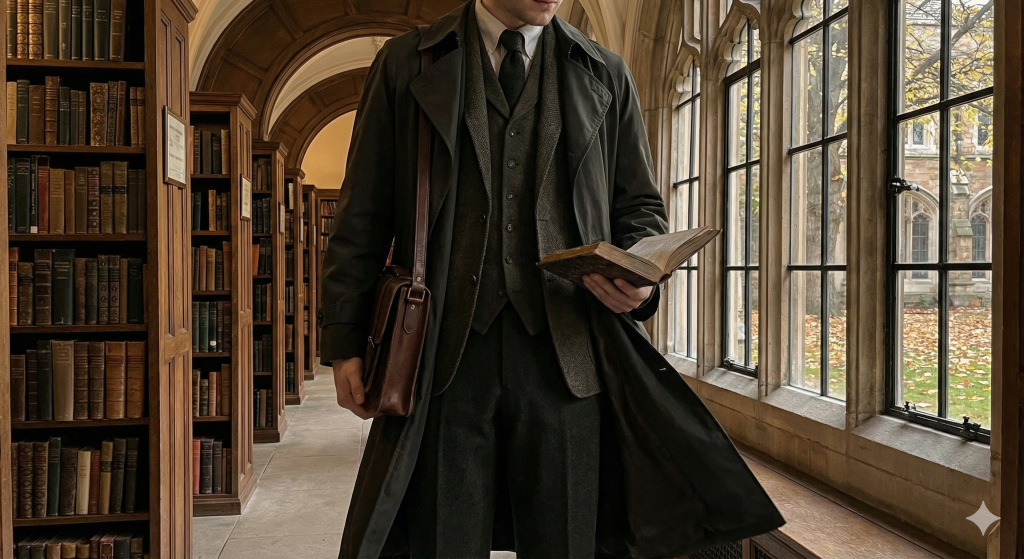
When the temperature drops, your blazer won’t be enough. A double-breasted Greatcoat in a dark navy or espresso is the move. It should be heavy—if it doesn’t feel a bit burdensome on the shoulders, it’s probably not warm enough for a true autumn transition.
8. The Fitted Waistcoat (Vest)
Borrowing directly from traditional menswear, a tailored waistcoat worn over a shirt (minus the jacket) is the “working scholar” look. It’s practical for indoor layering and keeps the torso warm without the bulk of a full sweater.
9. Corduroy Blazers or Slacks
Corduroy provides a much-needed visual break from flat wools. I prefer a fine-wale cord (more ribs per inch) for a more sophisticated, velvet-adjacent look, whereas a wide-wale cord feels more rugged and “field study” appropriate.
10. The Chunky Turtleneck
On the coldest days, a thick ribbed turtleneck replaces the shirt and tie. Stick to merino wool blends to avoid the “itch factor” while maintaining that dense, intellectual silhouette that frames the face perfectly under a heavy coat.
Textures and Fabrics: From Heavy Tweeds to Mulberry Silk
The tactile weight of a garment is what separates a costume from a curated, lived-in wardrobe. When we build a dark academia rotation for the colder months, the interplay of light and shadow across different weaves becomes our primary tool. Fall 2026 demands a shift away from flat, synthetic blends toward textiles that boast genuine depth and historical provenance.
I always prioritize Heavyweight Tweeds as the anchor. We look for genuine Donegal or Harris tweeds, specifically those weighing north of 350 grams per square meter. The beauty of these robust wools lies in their subtle flecks of contrasting yarn—threads of moss green, rusted copper, and deep oxblood woven into a charcoal base. This uneven, homespun texture provides a structured silhouette that holds its shape brilliantly in oversized outerwear and pleated trousers, offering exceptional insulation against November drafts.
To prevent the look from becoming overly stiff or suffocating, we introduce Mulberry Silk as the necessary friction-free base layer. The juxtaposition of a heavy, coarse wool against a liquid-like 19-momme silk blouse is a foundational styling technique in my studio. Silk catches the muted autumn light, offering a soft sheen that breaks up the dense, matte finish of surrounding knitwear. I recommend sourcing sand-washed silk finishes; they dial back the high-gloss shine, keeping the look restrained, matte, and authentic to a scholarly aesthetic.
Beyond the extremes of heavy wool and fluid silk, the mid-layers rely heavily on specific fabric mechanics. Here is how we break down the essential supporting textures:
| Fabric Type | Technical Specification | Styling Application |
|---|---|---|
| Corduroy | Low-wale count (8-wale or thicker jumbo cord) | The wider the wale, the deeper the shadows cast within the ridges. Ideal for unstructured blazers and straight-leg trousers to add a velvet-like depth without the formality. |
| Merino & Cashmere | Varying gauge (12-gauge vs. 5-gauge) | A fine 12-gauge merino roll-neck offers a sleek silhouette for slipping under tight tailoring. A chunky 5-gauge cable knit provides the necessary bulk to act as standalone outerwear. |
| Brushed Cotton Twill | ‘Peach’ finished surface | Crisp poplin often feels too stark for this aesthetic. Brushed cotton has a slightly fuzzed surface that visually bridges the gap between glossy silk and rugged tweed. |
Mastering this aesthetic requires a deliberate clash in hand-feel. When I am pulling looks for an editorial, the most successful outfits involve stacking these opposing textures: a structured, coarse herringbone coat draped over a fluid silk mid-length dress, anchored by thick ribbed-knit wool tights. It is this calculated, multi-dimensional profile that elevates the academic look from a basic uniform to high-level fashion.
The Color Palette: Beyond Classic Charcoal and Espresso
While charcoal, espresso, and raven black remain the structural pillars of the academic look, the Fall 2026 season demands a more nuanced chromatic strategy. We are moving away from the “costume” feel of monochromatic gloom and toward a sophisticated, multidimensional palette that reflects a literal “lived-in luxury” aesthetic. I’ve observed a significant pivot in high-end editorial styling toward what I call Oxidized Mid-Tones—colors that feel like they’ve aged within the walls of a centuries-old infirmary or a damp stone library.
To elevate your autumn rotation, focus on these three specific color expansions:
- The Desaturated Verdant Range: Trade basic forest green for Antique Moss and Pressed Fern. These shades contain higher grey undertones, making them read as neutrals rather than “pops” of color. They pair exceptionally well with the heavy tweeds mentioned earlier, providing a bridge between the organic and the scholarly.
- The “Dried Blood” & Ochre Intersection: We are seeing a massive resurgence of Blackened Plum and Burnt Sienna. Instead of bright reds, look for hues that mimic dried ink or rusted iron. A pair of corduroy trousers in a deep, dusty ochre can break the monotony of a grey blazer without sacrificing the serious, intellectual silhouette.
- Atmospheric Blues: Move beyond Navy. The 2026 trend focuses on Stormcloud Grey-Blue and Deep Teal. These shades offer a cooler contrast to the warmth of leather accessories and brass hardware, creating a visual “chill” that perfectly suits the late October atmosphere.
For those looking to master the tonal transition, I recommend following this Layering Color Ratio to maintain the aesthetic’s integrity while introducing variety:
| Layer Type | Recommended Tone | Effect |
|---|---|---|
| Base Layer (Shirt/Turtleneck) | Parchment, Bone, or Dusty Lavender | Softens the face; provides high-contrast “academic paper” feel. |
| Mid-Layer (Vest/Knit) | Antique Moss or Weathered Copper | Adds depth and prevents the look from feeling like a uniform. |
| Outerwear (Overcoat/Blazer) | Deep Graphite or Bitter Chocolate | Anchors the outfit in traditionalism and maintains the silhouette. |
A frequent mistake I see is relying too heavily on pure white. In the context of Fall 2026, pure white is often too jarring. I always steer my clients toward Ecru or Faded Calico. These “dirty” whites harmonize with the natural yellowing of vintage book pages and integrate seamlessly with the muted, desaturated tones that define this year’s sophisticated take on the scholar’s uniform.
5 Curated Dark Academia Outfit Ideas for Every Autumn Occasion
Translating the moodboard into wearable, daily ensembles requires a deliberate approach to proportion and context. I always advise my clients to dress for the specific narrative of their day. Here are five distinct styling formulas we are utilizing this fall to bring the aesthetic out of the archives and onto the streets.
The ‘Library Researcher’: Layering Knitwear and Pleated Skirts
This look hinges on the tension between structured academic uniforms and lived-in comfort. I start with a heavy wool-blend pleated midi skirt—preferably in a muted charcoal or faded black—as the anchor. The key is in the knitwear layering: a fitted, fine-gauge merino wool turtleneck worn beneath a slightly oversized, chunky cable-knit vest. Let the collar and cuffs of a crisp poplin shirt peek out just enough to frame the face and wrists. Pair this with opaque tights and polished leather loafers. The silhouette remains grounded, allowing for ease of movement while projecting an air of deep focus.
The ‘Midnight Poet’: Styling Oversized Blazers and Tailored Trousers
For evening lectures or late-night coffee runs, the silhouette loosens up. The focal point here is a dramatically oversized blazer, ideally sourced in a heavy herringbone or a dark, bruised-plum wool. We drape this over high-waisted, wide-leg tailored trousers that pool slightly over a sharp-toed leather boot. Beneath the blazer, skip the stiff collar entirely; opt for a fluid silk camisole or a fine-ribbed boat neck top to add a hint of softness against the masculine tailoring. Push the blazer sleeves up to the elbows to expose layered leather strap watches or subtle gold hardware.
The ‘Art History Scholar’: Incorporating Vintage Accessories and Brogues
This ensemble is where your curated vintage pieces do the heavy lifting. The base is simple: a straight-leg corduroy pant in deep espresso, paired with a fitted, earthy-toned cashmere sweater. The transformation happens through the accessories. I recommend incorporating a well-worn leather satchel with brass hardware, a tortoiseshell hair clip to loosely secure the hair, and an assortment of vintage cameo or signet rings. Ground the look with authentic wingtip brogues. The rich texture of the corduroy combined with the patinated leather and metal creates a visually arresting, historically rich outfit.
The ‘Campus Classicist’: The Midi Trench and Pinstripe Combo
When navigating unpredictable autumn weather, a lightweight wool trench coat in an olive or deep navy is indispensable. Wear it belted tightly over a pinstripe button-down shirt tucked into straight-leg dark wash denim or wool trousers. Keep the trench lapels popped against the wind. I often add a silk scarf tied tightly at the neck in a dark floral or paisley motif to break up the linear geometry of the pinstripes. Finish with classic Chelsea boots for a streamlined, functional aesthetic that nods heavily to Ivy League traditions.
The ‘Weekend Antiquarian’: Chunky Cardigans and Plaid Trousers
Weekend styling demands a relaxed yet intentional approach. Swap the rigid blazer for an oversized, shawl-collar cardigan in a rich mahogany or moss green. The cardigan should act as outerwear, layered over a thin thermal henley. Pair this top half with high-rise, wide-leg plaid trousers—think muted tartans or Prince of Wales checks. The juxtaposition of the cozy, slouchy knit against the sharp, mathematical pattern of the trousers creates a perfectly balanced off-duty look. Add lace-up leather combat boots to give the outfit a slightly more rugged, adventurous edge.
The ‘Library Researcher’: Layering Knitwear and Pleated Skirts
This look is the definitive backbone of the aesthetic, designed for those long hours spent among mahogany bookshelves. To nail the Library Researcher vibe this fall, we are moving away from the “costume” feel of years past and leaning into high-quality tactile layering that looks lived-in yet sharp.
The foundation starts with the pleated midi skirt. For 2026, I recommend opting for a heavier wool blend or a crisp gabardine in deep forest green or a muted houndstooth. The key to avoiding a school-uniform cliché is the length; aim for mid-calf. This creates a more mature, scholarly silhouette that balances the bulk of your upper layers.
Mastering the Knitwear Stack:
- The Base Layer: Start with a slim-fit pima cotton turtleneck or a lightweight mock-neck. This acts as a thermal barrier and adds a pop of contrasting texture against the skin.
- The Mid-Layer: Introduce a classic V-neck cricket sweater or a cable-knit vest. The goal here is “intellectual volume.” Look for pieces with slightly dropped shoulders to allow for movement while reaching for those top-shelf archives.
- The Focal Point: A chunky, oversized cardigan in a “scholarly” knit—think fisherman ribs or intricate aran patterns. In my experience, choosing a cardigan with leather-bound buttons or horn toggles provides that authentic vintage weight that synthetic fast-fashion misses.
To refine the silhouette, use the “French Tuck” method with your middle knit layer. By tucking just the front inch of your sweater into the waistband of the pleated skirt, you define the waist without losing the cozy, oversized appeal of the knitwear. If the weather turns particularly sharp, we suggest adding a thin leather belt over the cardigan itself—a styling trick borrowed from mid-century academic portraiture that instantly elevates the outfit from casual to curated.
| Element | The “Researcher” Choice | Styling Pro-Tip |
|---|---|---|
| Hosiery | 80-denier opaque tights in espresso or burgundy. | Matches the footwear to elongate the leg line. |
| Footwear | T-strap Mary Janes or Chunky Oxfords. | Ensure a matte finish; high-gloss patent can look too juvenile for this specific look. |
| The “Clutter” | A leather satchel and a pair of blue-light glasses. | The satchel should be worn crossbody to compress the knitwear layers slightly. |
We focus on the tension between textures: the stiffness of the pleats against the softness of the mohair or wool. If your skirt is patterned (like a Glen plaid), keep your knits solid but varying in stitch density. This prevents the outfit from looking flat in the dim lighting of a university hall.
The ‘Midnight Poet’: Styling Oversized Blazers and Tailored Trousers
Achieving the “Midnight Poet” aesthetic relies entirely on mastering the deliberate tension between slouch and structure. When I style this specific look for autumn editorials, the focal point is always an aggressively oversized blazer paired with meticulously tailored trousers. We are not simply telling you to size up; we are sourcing garments with intentional drop shoulders, exaggerated lapels, and enough drape to look romantically disheveled yet sartorially calculated.
The blazer acts as your armor. I recommend seeking out men’s suiting jackets in substantial autumn weights—think worsted wool or a dense houndstooth blend—that hold a rigid shoulder line but sweep fluidly past the hips. The key to making this work without looking costume-like is sleeve management. Rolling the cuffs to expose a contrasting silk lining or a distressed knit cuff from your underlayer instantly prevents the garment from swallowing your frame. It adds that lived-in, ink-stained writer vibe that makes the look authentic.
To anchor the voluminous top half, the trousers must be sharply constructed. We pair these slouchy jackets with high-waisted, double-pleated trousers. Wide-leg cuts are the definitive standard for Fall 2026, pooling slightly over a heavy loafer or an angular boot. The visual contrast between a sharp, defined waistline and the cascading fabric of an unbuttoned, oversized blazer creates a highly compelling silhouette.
Here are my studio rules for nailing the proportions of the Midnight Poet:
- The Base Layer Rule: Keep the foundation sleek. A skin-tight ribbed turtleneck or a thin, slightly unbuttoned silk blouse tucked tightly into the trousers ensures your waist remains visible against the blazer’s bulk.
- The Belted Interruption: Introduce a thin, worn-leather belt with a tarnished brass buckle. This breaks up the visual weight and draws the eye to the narrowest part of the silhouette.
- Sleeve Scrounging: Never leave the blazer sleeves pristine. Push them up the forearms. In photo shoots, we use hidden elastic bands just above the elbows to keep heavy wool sleeves scrunched, exposing the wrists and adding necessary casualness to an otherwise formal garment.
This specific combination is highly responsive to fabric movement. The way a heavy wool-blend blazer catches the autumn wind while you are walking across a campus quad, contrasting with the razor-sharp crease of worsted wool trousers, delivers the exact visual narrative of the brooding creative. It is practical for transitional weather, intensely comfortable, and visually striking.
The ‘Art History Scholar’: Incorporating Vintage Accessories and Brogues
The “Art History Scholar” look is arguably the most tactile sub-genre of Dark Academia. While the researcher focuses on utility, the scholar leans into visual storytelling through textures and curated artifacts. To nail this aesthetic for Fall 2026, we are moving away from the “costume” feel of years past and toward a sophisticated, archival-inspired silhouette that feels lived-in yet intentional.
The Foundational Footwear: Brogues and Oxfords
You cannot achieve this look without the structural integrity of a proper leather shoe. This season, we are seeing a shift toward commando soles—thick, rugged rubber bases that contrast beautifully with delicate wool hosiery.
- The Wingtip Detail: Look for heavy perforations. A chocolate brown or oxblood grain leather adds a level of depth that flat black simply cannot provide.
- The Sock Game: I recommend pairing your brogues with ribbed cashmere or marled wool socks in ochre or forest green. Allow about two inches of the sock to peak out above the shoe to bridge the gap between your footwear and cropped trousers.
- Pro Tip: Invest in a pair of cedar shoe trees. The “Art History Scholar” values longevity; your footwear should look like it has survived a decade of museum tours, not a single season of fast fashion.
Vintage Accessories: The Narrative Elements
Accessories are where you inject personality and “academic clutter” into the outfit. We aren’t just looking for jewelry; we are looking for conversation starters.
| Accessory Type | The 2026 Update | Styling Note |
|---|---|---|
| Timepieces | Small-faced tank watches with weathered leather straps. | Gold hardware is preferred over silver to maintain the “warm” academic glow. |
| Eyewear | Tortoiseshell “Panto” frames or wire-rimmed rounds. | Even if you don’t need a prescription, blue-light lenses add that essential studious edge. |
| Brooches | Anatomical sketches, gold cicadas, or heraldic shields. | Pin these to the lapel of a heavy tweed blazer rather than a delicate knit. |
Practical Execution: The “Cluttered” Silhouette
To execute this look, I suggest starting with a base of corduroy wide-leg trousers. Use a leather belt with a brass buckle—preferably one with a slight patina. The “Art History” element comes from the layering of a silk neck scarf tucked under a v-neck sweater. This creates a focal point near the face that mimics the portraits you’d find in a gallery.
Lastly, consider the “carry.” A leather satchel is the standard, but for a true 2026 scholar vibe, I prefer a weathered leather portfolio or a vintage doctor’s bag. It suggests you are transporting rare manuscripts or sketchbooks, completing the transition from someone who just wears clothes to someone who inhabits a world.
Advanced Styling Techniques: Mastering the Art of Layering and Silhouette
The true mastery of the Dark Academia aesthetic lies not merely in the individual garments you own, but in how you architect them. When I style for autumn editorial shoots, layering is treated as a structural discipline. We are moving past the basic sweater-over-shirt combination; the current approach demands intentional geometry and a deliberate play on proportions.
To master the silhouette, you must understand the principle of Visual Weight Distribution. Heavy, academic fabrics can easily swallow your frame. To counter this, I rely on the “Volume-to-Structure” ratio. If your base layer consists of voluminous, wide-leg wool trousers and an oversized Oxford, you must anchor the look with a sharply tailored, padded-shoulder blazer or a structured waistcoat. The crisp lines of the tailoring create an architectural frame, preventing the heavy, relaxed lower half from looking unkempt.
Here are the specific layering mechanics I use to build depth without bulk:
- The Quad-Layer Neckline: This is my signature technique for achieving that quintessential scholarly depth. Start with a fine-gauge, skin-tight merino turtleneck. Layer a crisp poplin dress shirt over it, leaving the top three buttons undone. Add a deep V-neck wool vest or a low-cut cardigan, and finish with a structured overcoat. The varying necklines create a receding V-shape that frames the face and adds immense visual interest while keeping the torso streamlined.
- Staggered Hemlines: Perfect layering requires intentional dishevelment. Never let your hems align perfectly. Allow the curved tail of your button-down to peek exactly two to three inches below the hem of a cropped knit sweater. When pairing a midi skirt with a trench coat, ensure the skirt drops several inches below the coat’s hem to create a dynamic, sweeping movement as you walk through campus or city streets.
- Waist-Cinching Heavy Knits: Bulky cardigans and oversized blazers are notorious for destroying silhouettes. Instead of wearing them open and loose, I frequently use a thin, vintage leather belt cinched directly over the thick outer layer, right at the natural waist. This instantly transforms a shapeless garment into a structured, hourglass-enhancing piece that flatters the figure while retaining the heavy, academic mood.
A frequently overlooked element of silhouette manipulation is the treatment of the sleeves. I always advise pushing up or rolling the sleeves of your heaviest outer layer—whether it is a tweed blazer or a heavy cardigan—to expose the cuffs of your shirt, which in turn reveals the edge of a slim turtleneck or bare skin. This creates micro-layering at the wrists and exposes the narrowest part of the arm, which instantly slims the overall silhouette. The goal is to look as though you were deeply engrossed in a dusty tome and hastily threw on fine tailoring to brave the autumn chill, achieving an ensemble that is perfectly calculated yet reads as entirely effortless.
Sustainable Sourcing: How to Thrift the Ultimate Academic Look
Thrifting isn’t just an eco-conscious afterthought; for the Dark Academia aesthetic, it is the primary engine for authenticity. The very soul of this look relies on pieces that hold history and physical weight. As I scour vintage racks and estate sales season after season, I find that modern fast-fashion retailers simply cannot replicate the drape of a 1980s pure wool blazer or the hand-feel of a decades-old Scottish cashmere cardigan. To master sustainable sourcing and build a wardrobe that genuinely looks lived-in, you have to approach thrift stores and digital resale platforms like an archivist hunting for primary sources.
When physical thrifting, your success rate depends entirely on where you look and how you filter the racks. I always advise clients to implement the following in-store strategies:
- Raid the Men’s Section: Skip the contemporary womenswear entirely and head straight for men’s tailoring and knitwear. This is where the authentic oversized, slouchy silhouettes naturally live. Look for men’s suiting trousers with genuine double pleats and substantial hems that hold their shape.
- Master the “Touch Test”: Thrift stores are notoriously crowded and often poorly lit. Train your hands to bypass synthetics by touch alone. You are feeling for the rough bite of Harris Tweed, the heavy drape of worsted wool, and the distinct, cool slip of vintage silk. If the composition tag reads “poly-blend,” leave it on the rack.
- Examine Hardware and Linings: A dead giveaway of a high-quality vintage piece is its hardware. Look for genuine leather football buttons, heavy horn toggles, and solid brass zippers. Inspect the lining; cupro or silk linings in blazers indicate a garment built to last, unlike the cheap acetate ubiquitous in modern production.
Navigating online resale platforms requires a completely different tactical approach. Searching generic terms like “dark academia” on Depop, Poshmark, or Vestiaire Collective will only surface marked-up, trend-chasing synthetic pieces. To uncover the actual hidden gems at reasonable price points, you must use precise, era-specific terminology. I have compiled my personal keyword matrix for digital sourcing:
| Item Category | Avoid Generic Searches | Pro Search Terms (The Insider Keys) |
|---|---|---|
| Knitwear | “Dark academia sweater” | “Vintage Pringle of Scotland”, “Aran wool cable knit”, “Shetland wool cardigan”, “100% lambswool vest” |
| Blazers | “Preppy blazer” | “Professor blazer”, “Vintage Brooks Brothers tweed”, “Houndstooth wool sportcoat”, “Elbow patch corduroy jacket” |
| Bottoms | “Pleated school skirt” | “Pendleton wool midi”, “Vintage worsted wool trousers double pleat”, “High-waisted wool slacks men’s” |
| Outerwear | “Trench coat” | “Burberrys (pre-1999 label)”, “Vintage Aquascutum balmacaan”, “Heavyweight wool overcoat raglan sleeve” |
Finding the perfect vintage piece is only half the battle; the other half is securing the fit. Sustainable fashion inherently means investing in longevity, and nothing ensures longevity quite like professional tailoring. When I find a vintage Ralph Lauren wool trouser that fits flawlessly at the waist but balloons awkwardly at the ankle, I never pass it up. Factoring a tailoring fee into your thrifting budget transforms a dated, boxy thrift find into a bespoke-looking garment. A skilled tailor can take in the waist of a heavy wool skirt, taper a trouser leg to modernize the silhouette, or adjust the shoulder pads on an 80s blazer to achieve that exact degree of scholarly slouch we are aiming for this fall.
Footwear and Accessories: The Final Touches for an Authentic Look
The transition from a mere enthusiast to a true dark academia devotee happens at the ankles and the extremities. We often see novices nail the trench coat but falter with flimsy sneakers or plastic-looking belts—mistakes that instantly shatter the “founding member of a secret society” illusion. For Fall 2026, the emphasis has shifted toward structural integrity and period-accurate hardware.
The Foundational Footwear
In our experience, the weight of your step defines the silhouette. We are moving away from the ultra-chunky “clown” soles of previous years and returning to the refined, stacked leather heels that offer a more intellectual gravitas.
- The Oxford & Brogue: This remains the non-negotiable anchor. Look for burnished calfskin in deep oxblood or mahogany. The “perforation” (the decorative holes) shouldn’t just be aesthetic; high-quality broguing serves as a nod to the style’s rugged, Irish countryside roots.
- The Commando-Sole Chelsea: For those damp November campus walks, we recommend a Chelsea boot with a discreet commando sole. It provides the necessary grip without sacrificing the sleek profile required to tuck under tailored trousers.
- The T-Strap Mary Jane: A staple for the “Art History Scholar” look. To keep it from looking too juvenile, opt for a pointed or almond toe rather than a rounded one, paired with heavy ribbed wool socks.
The “Intellectual” Accessory Kit
Accessories in this subculture shouldn’t look like “fast fashion” add-ons; they should look like heirlooms. We focus on pieces that suggest a life spent in transit between archives and dimly lit cafes.
| Item | The “Expert” Detail to Look For | Styling Note |
|---|---|---|
| Leather Satchel | Unlined, vegetable-tanned leather with brass buckles. | Avoid zippers; the ritual of unbuckling a bag adds to the performative nature of the aesthetic. |
| Spectacles | Tortoiseshell or gold-rimmed “Panto” frames. | Even if you have 20/20 vision, high-quality blue-light lenses in vintage frames complete the “exhausted researcher” vibe. |
| Headwear | The unstructured wool beret or a stiff-brimmed felt Fedora. | Tilt the beret sharply to one side; it should look intentional, not like an afterthought. |
Textural Finishes: Ties, Socks, and Belts
We believe the devil is in the hosiery. A common pitfall is wearing white athletic socks with loafers. Instead, we advocate for merino wool or cashmere blends in forest green, mustard, or slate grey. The texture of the sock should bridge the gap between the smooth leather of the shoe and the heavy wool of the trouser.
For belts, skip the loud designer logos. A slim, 2.5cm dark brown leather belt with a simple dull-gold square buckle is the industry standard. If you’re incorporating a necktie, ignore the shiny silk varieties found in corporate boardrooms. You want knitted wool ties or ancient madder silk—fabrics that possess a matte, chalky finish and a vintage “hand-feel” that suggests they’ve been sitting in a trunk since 1945.
Lastly, consider the “functional” props: a fountain pen clipped to a pocket or a leather-bound notebook. These aren’t just accessories; they are the tools of the trade that transform a costume into a lifestyle.
FAQ
Over the years, I’ve seen the Dark Academia movement evolve from a niche internet subculture into a seasonal powerhouse that dictates autumn retail cycles. Because I live and breathe these trends, I know the difference between a costume and a cohesive wardrobe. Here are the most pressing questions I receive from stylists and enthusiasts looking to nail the look this fall.
| The Common Query | The Expert Insight |
|---|---|
| Can I pull off Dark Academia if I live in a warm climate? | Focus on “visual weight” rather than actual thermal weight. Swap heavy wool for breathable linen-cotton blends in chocolate brown, or utilize lightweight vests over short-sleeved silk blouses. You get the silhouette without the heatstroke. |
| How do I avoid looking like I’m wearing a school uniform? | It’s all about the silhouette. Avoid the “preppy” trap by opting for oversized, slightly distressed vintage blazers and wide-leg trousers instead of fitted polos and pleated minis. Mix in “un-academic” textures like leather or sheer lace to break the mold. |
| Is the aesthetic still relevant for 2026? | Absolutely, though it has shifted toward “Sustainable Scholasticism.” We are seeing a move away from fast-fashion polyester blazers toward high-quality, second-hand natural fibers. It’s less about the trend and more about the lifestyle of longevity and intellectual curiosity. |
How can I make Dark Academia look professional for the office?
Transitioning this look to a corporate environment requires a lean toward “Corporate Academia.” Replace the chunky Doc Martens with polished oxfords or loafers with a subtle platform. Use a monochromatic palette—think charcoal grey or deep navy—and ensure your “oversized” elements are intentional rather than sloppy. A crisp, high-collared white shirt tucked into high-waisted wool trousers remains the ultimate power move.
What are the “investment pieces” worth spending more on?
If you’re going to splurge, do it on outerwear and footwear. A 100% wool trench or a heavy tweed blazer will last a decade and only looks better as it develops a “patina” of wear. Likewise, high-quality leather brogues are essential; cheap synthetic leather won’t provide the structural integrity needed for that heavy-set academic silhouette.
Is there a way to incorporate color without breaking the aesthetic?
We often get stuck in the “black and brown” loop. To elevate the look this season, I recommend jewel-toned accents. Incorporate “Oxford Blue,” “Oxblood Red,” or a deep “Forest Green” through your knitwear or neckties. The key is to keep the saturation high but the brightness low—muted, moody tones are your best friends.
How do I maintain my wool and tweed pieces?
Stop over-washing. Wool is naturally antimicrobial. Invest in a high-quality clothes brush to remove dust and hair after each wear. For pills, use a fabric shaver carefully. Between seasons, store your knits folded rather than hanging to prevent “shoulder nipples” and stretching, and always use cedar blocks to ward off moths.