
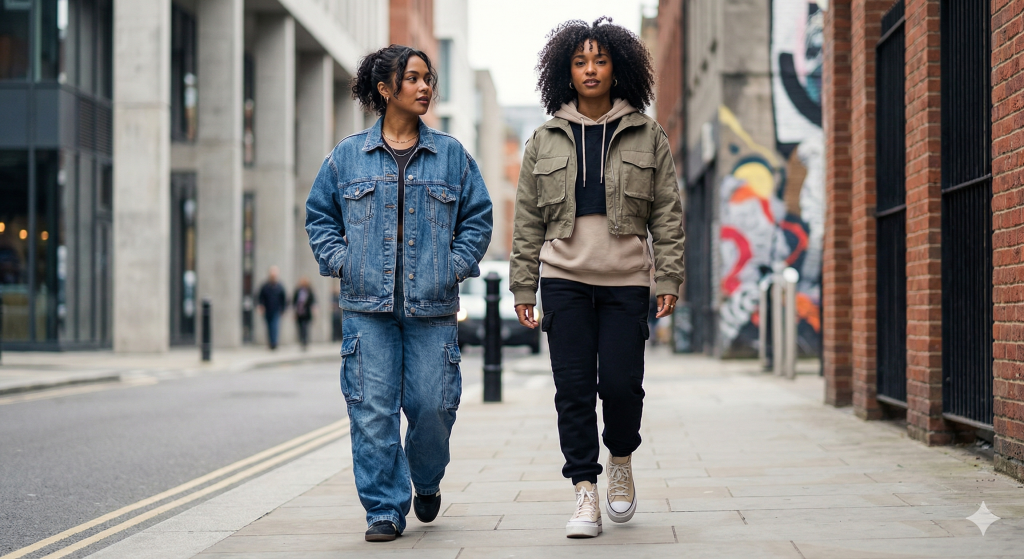
The Evolution of Streetwear Fashion Trends for Petite Women
For decades, streetwear was a boys’ club built entirely around a one-size-fits-all mentality that aggressively alienated anyone under 5’4″. I remember the early 2000s well, watching petite women practically drown in heavy selvedge denim and XXL graphic tees. If we wanted to participate in skate culture or hip-hop-inspired aesthetics, our only options were shopping in the boys’ department or spending a fortune at the tailor. The industry’s approach to female consumers was frustratingly lazy: brands would simply scale down men’s patterns, completely ignoring how a drop-shoulder or a longline hem distorts a shorter silhouette.
The turning point I observed hit around the late 2010s when high fashion collided with street culture. As luxury houses began adopting urban aesthetics, fit and tailoring became non-negotiable. We saw a mass migration away from the chaotic, fabric-heavy layering of the past into more intentional, structural pieces. The market finally realized that petite women wanted the attitude of streetwear without the structural collapse.
A massive driver of this evolution came from global influences. Asian streetwear hubs—specifically Seoul and Tokyo—fundamentally shifted the market. Designers in these regions naturally catered to smaller frames and pioneered what I call the “engineered boxy” cut. Western brands took extensive notes, leading to several permanent shifts in how streetwear is manufactured for smaller frames today:
- The Rise of the Crop: Shifting away from longline tees that swallow the torso, giving way to boxy, abbreviated cuts that end at the natural waist.
- Built-in Adjustability: The integration of bungee cords, toggles, and velcro closures on oversized items, allowing petite wearers to cinch and control volume instantly.
- Proportional Drop-Shoulders: Redesigning the armhole drop so the seam sits intentionally on the upper bicep, rather than slouching down to the elbow and creating a sloppy appearance.
Today, as an industry forecaster, I track a completely different reality. Streetwear for petite women is no longer an afterthought or a DIY tailoring project. It has evolved into a highly specialized sub-category defined by strategic volume rather than accidental bulk, allowing us to command the aesthetic entirely on our own terms.
Mastering Proportions: How to Style Oversized Pieces on a Shorter Frame
The biggest myth in our industry is that petite women cannot wear oversized streetwear. I hear this constantly from clients who are terrified of drowning in heavy fleece and rigid denim. The secret isn’t shrinking the garments down to standard petite sizing; it’s aggressively manipulating the drape. When working with a frame under 5’4″, every inch of fabric needs a designated purpose. We want to achieve an intentional slouch, avoiding the dreaded “borrowed from my older brother” accident. It comes down to anchoring the volume. If you wear a massive, drop-shoulder hoodie, you must anchor it by exposing the wrists, creating a structured neckline, or executing a strategic front tuck. Proportion is an illusion you can control.
The Rule of Thirds for Baggy Silhouettes
In editorial styling, we rely entirely on the rule of thirds to trick the eye, and this principle is non-negotiable for petite streetwear. Never split your body into a 50/50 ratio—meaning your top and bottom should never visually end at the exact midpoint of your height. A long, uninterrupted line creates the illusion of a taller frame. When I dress a 5’1″ client in pooling, wide-leg denim, I pair it with a baby tee or a tightly cropped jacket that ends exactly at the natural waist. This creates a 1/3 (top) to 2/3 (bottom) ratio, instantly elongating the legs.
If you want to wear an oversized, vintage graphic tee—a staple in this scene—do not leave it hanging past your hips. Letting a boxy shirt hit the widest part of your thighs cuts your legs in half. Instead, use a styling band or a shoelace tied around your waist to crop the tee under the hem, or utilize an asymmetrical half-tuck to restore that essential 1/3 visual break.
High-Waisted vs. Low-Rise: What Works Best
Streetwear bottoms are currently in a tug-of-war between 90s high-waist cuts and Y2K low-rise silhouettes, leaving many shorter women guessing which style to invest in. Let me give you the industry consensus: high-waisted cuts are your absolute safety net. They artificially raise your waistline, allowing you to wear the baggiest, most aggressive parachute or cargo pants while still appearing tall. The high waist compensates for the lateral volume.
However, low-rise is entirely wearable for petites if styled with precision. The trick to low-rise on a shorter frame is continuous color blocking and strategic skin exposure. If you opt for low-rise track pants, pair them with a tonal or matching top to create an unbroken vertical line. Always ensure your midriff is slightly visible. That flash of skin acts as a visual reset, preventing the dropped waist from visually shortening your inseam.
My Studio Checklist for Managing Oversized Pieces:
- Fabric Weight Dictates Volume: Heavy, stiff raw denim or heavyweight terry cotton will box out a petite frame. Opt for oversized pieces in softer, draping fabrics like washed nylon or lightweight fleece that fall closer to the body rather than standing away from it.
- The “Flash of Skin” Technique: Baggy garments easily consume small frames. Pushing up oversized sleeves to show your forearms, or unzipping a track jacket to expose the collarbone, draws the eye upward and breaks up blocks of heavy fabric.
- Hemline Management: The hem of a wide-leg pant should break perfectly over the vamp of your sneaker. Dragging hems instantly telegraph that the clothes do not fit, destroying the illusion of intentional streetwear styling.
The Rule of Thirds for Baggy Silhouettes
Mastering oversized streetwear on a petite frame comes down to a simple visual math equation: the rule of thirds. I constantly remind my styling clients that cutting the body strictly in half—say, wearing an untucked, mid-thigh t-shirt over baggy jeans—creates a visually stumpy silhouette. Instead, we want to divide your look into a 1:2 ratio. You are aiming for either one-third top to two-thirds bottom, or two-thirds top to one-third bottom. This asymmetry forces the eye to travel upward, instantly elongating your stature even when you are working with heavy cotton fleece or stiff, rigid denim.
When working with the exaggerated volumes typical of streetwear, this rule becomes your styling anchor. Let’s break down exactly how we execute this in everyday wear:
- The 1/3 Top + 2/3 Bottom Formula: If you are wearing ultra-baggy parachute pants or pooling wide-leg cargos, those bottoms claim the majority of your visual real estate. To prevent the heavy fabric from swallowing you whole, your top must be cropped or tightly tucked to establish a distinctly high baseline. A ribbed tank, a tight bodysuit, or a cropped zip-up hitting just above the navel creates a sharp visual break, defining your waist before the volume of the pants takes over.
- The 2/3 Top + 1/3 Bottom Formula: When the focal point of your fit is a massive, boxy graphic tee or a heavy oversized bomber jacket, let that piece act as the two-thirds. We balance this heavy top block by aggressively exposing the legs. Pairing an XXL vintage hoodie with micro-shorts, a pleated tennis skirt, or utilizing the “no-pants” trend with sheer tights gives your legs the maximum possible visible length.
To make this second nature, I have put together a quick studio reference matrix for pairing your streetwear heavyweights without losing your proportions:
| The Oversized Statement Piece | Rule of Thirds Placement | The Petite-Friendly Pairing |
|---|---|---|
| Puddle-hem Cargo Pants | Bottom 2/3 | Cropped baby tee or tight corset (Top 1/3) |
| XXL Vintage Graphic Hoodie | Top 2/3 | Bike shorts or micro mini skirt (Bottom 1/3) |
| Baggy Carpenter Jeans | Bottom 2/3 | Asymmetrical cropped knit (Top 1/3) |
| Boxy Chore Jacket | Top 2/3 | Fitted straight-leg sweatpants tucked into socks (Bottom 1/3) |
By strictly enforcing this 1:2 visual ratio, we maintain the relaxed, anti-fit essence of streetwear while deliberately engineering the proportions to flatter, rather than overwhelm, a shorter frame.
High-Waisted vs. Low-Rise: What Works Best
When styling clients who are under 5’4″, the debate between high-waisted and low-rise bottoms is the single most frequent proportion battleground I encounter. The industry default has always been to slap high-waisted everything on shorter frames to elongate the leg line. A high-rise baggy cargo or wide-leg denim sitting precisely at the natural waist is a bulletproof strategy in streetwear. It shifts the visual center of gravity upward, tricking the eye into perceiving a longer lower half. If you are pairing oversized streetwear bottoms with a bulky, cropped puffer jacket, high-waisted cuts are your non-negotiable anchor.
But streetwear is deeply rooted in subversion, and the massive resurgence of slouchy, low-rise fits cannot be ignored. Traditional style mandates dictate that petites should avoid low-rise entirely because it visually shortens the legs and stretches the torso. I strongly disagree. You can absolutely pull off low-rise streetwear on a shorter frame, but it requires highly calculated styling to prevent the heavier fabrics from dragging your silhouette down.
| Rise Type | Streetwear Styling Rules for Petites | Ideal Top Pairings |
|---|---|---|
| High-Waisted | Use this as your foundation when building heavily layered streetwear looks. Let the pants balloon out at the hips and drape, but ensure the waistband sits exactly at your narrowest point to maintain structure. | French-tucked oversized graphic tees, structured bodices, or heavy cropped hoodies. |
| Low-Rise | You must compensate for the dropped waistline by showing skin. A visible break between the torso and the pants creates a new set of proportions, stopping the torso from looking abnormally long. | Micro baby tees, ribbed tank tops, or an unbuttoned oversized flannel over a bralette. |
The secret to mastering low-rise on a petite frame lies in the shoes and the hem. If the waist drops, the sole of your shoe must rise. A low-rise parachute pant pooling slightly over a heavy, thick-soled sneaker physically restores the leg length that the lowered waistline took away. Conversely, high-waisted styles offer more flexibility with footwear, allowing you to rock lower-profile skate shoes without sacrificing visual height. Always remember to assess your outfit in a full-length mirror to ensure the break lines sit exactly where you intend them to.
Top Streetwear Aesthetics Tailored for Petites This Season
Right now, the streetwear scene is splintering into a few dominant micro-trends, and the industry shift is actually working in our favor. Having spent the last few weeks previewing upcoming collections in showrooms across Los Angeles and Tokyo, I am seeing a definitive move away from the heavy, unstructured hypebeast uniform. Instead, brands are focusing on curated, intentional fits that inherently flatter a petite frame without requiring an aggressive trip to the tailor.
Y2K Revival: Baby Tees and Parachute Pants
The core formula of the Y2K resurgence is practically engineered for shorter frames: the micro top paired with a voluminous bottom. The baby tee naturally hits right at the natural waist or slightly above, immediately establishing a higher waistline and elongating the legs. When styling this with parachute pants, the insider trick is to strictly hunt for styles featuring adjustable bungee toggles at the hems. This season, contemporary streetwear labels are cutting their parachute pants with a slightly higher rise and a less severe drop-crotch. By cinching the ankle toggle tight, you create a deliberate, stacked look over your sneakers. The fabric pools stylishly rather than dragging on the floor, completely bypassing the need for alterations while maintaining the authentic baggy aesthetic.
Gorpcore: Functional Utility Wear Without the Bulk
Gorpcore has historically been a nightmare for petites. Traditional outdoor gear is built for layering over thick winter clothing, resulting in rigid, excess fabric that easily swallows a 5’2″ frame. However, the current iteration of utility wear is significantly more forgiving. We are leaning heavily into micro-fleeces, cropped technical windbreakers, and slim-straight ripstop trousers. To execute this without looking like you are drowning in a sleeping bag, I always advise my clients to prioritize technical fabrics that drape smoothly rather than stiffen. Think lightweight Gore-Tex or soft-shell nylon instead of heavy, unyielding canvas. A cropped technical jacket stops cleanly above the hips, preserving your vertical line while delivering that coveted, rugged edge.
Minimalist Athleisure: Clean Lines and Strategic Layering
Minimalist athleisure serves as the quiet luxury equivalent within streetwear, relying heavily on monochromatic palettes and second-skin base layers contrasted with a single, highly structured oversized piece. For a petite silhouette, this aesthetic is an exercise in visual continuity. A seamless, matching set creates an unbroken vertical line from shoulder to ankle. The streetwear element is then introduced through outerwear—perhaps a dropped-shoulder nylon trench or a boxy, cropped puffer jacket. The sharp contrast between the hyper-fitted base layer and the geometric outerwear provides the illusion of height and high-fashion intentionality.
| Aesthetic | Petite Pitfall | Expert Fix This Season |
|---|---|---|
| Y2K Revival | Dragging hems on ultra-wide-leg pants. | Prioritize parachute pants with built-in ankle bungee toggles for a controlled, tailored stack. |
| Gorpcore | Stiff, heavy canvas materials that add boxy width. | Opt for lightweight ripstop nylon and cropped, soft-shell technical jackets to maintain your shape. |
| Minimalist Athleisure | Oversized hoodies disrupting the body’s natural lines. | Use tight, monochromatic base layers paired with exactly one cropped, boxy outerwear piece. |
Y2K Revival: Baby Tees and Parachute Pants
The resurgence of Y2K aesthetics is arguably the most petite-friendly streetwear movement we have seen in the last decade, primarily because it relies on micro-proportions on top to balance exaggerated volume on the bottom. While we already established the mechanics of volume control, the specific pairing of baby tees and parachute pants provides a ready-made formula that effortlessly flatters a shorter stature.
Forget drowning in heavy, oversized graphic tees. The baby tee is our secret weapon for immediate structural definition. As I regularly advise my styling clients, the tight, shrunken fit of a baby tee creates an anchor point for your outfit. When sourcing pieces, I look for cap sleeves or classic raglan cuts with a hemline that hits exactly at, or just one inch above, the natural waist. This specific crop organically raises the perceived waistline and elongates the legs, allowing you to play with heavily voluminous bottoms.
Parachute pants often carry the risk of swallowing a petite frame, but the Y2K iteration solves this through built-in adjustable hardware. The defining feature you need to leverage is the ankle bungee cord. Instead of leaving the hems wide and dragging—which instantly shortens the leg and ruins the shoe profile—pull the drawstrings tight to create a tapered balloon effect. This maintains the authentic streetwear edge while keeping the silhouette strictly contained.
To execute this look flawlessly on a frame under 5’4″, I recommend adhering to a few strict buying and styling parameters:
- Embrace the sliver of skin: Pairing a snug baby tee with mid-rise parachute pants creates a slight midriff exposure. This acts as a necessary visual break, preventing the outfit from reading as one solid, overwhelming block of fabric.
- Prioritize lightweight fabrics: Opt for crisp, ultra-light nylon rather than heavy canvas or thick cotton blends. The lighter drape prevents the baggy pants from adding excessive physical and visual bulk to your lower half.
- Hunt for the right inseam: The streetwear market is finally adapting to our sizing needs. Many core streetwear labels now offer “short” inseam options for parachute pants, specifically hitting the 28-inch to 29-inch mark. Always check the technical specifications for this measurement to avoid aggressive pooling at the ankles.
Gorpcore: Functional Utility Wear Without the Bulk
Gorpcore—named after the trail mix acronym “Good Ol’ Raisins and Peanuts”—is notoriously tricky for us shorter folks. The aesthetic relies heavily on mountaineering gear, which traditionally means heavy fleece, massive puffer coats, and drowning in waterproof nylon. But as someone who constantly styles 5’2” and under clients, I can tell you the secret to nailing this outdoorsy streetwear trend lies entirely in the hardware. Bungee cords, drawstrings, and adjustable toggles are your best friends here. Instead of avoiding technical wear, we just need to hack the fit.
Let’s look at outerwear first. A standard technical shell jacket will typically hit a petite frame right at the widest part of the hips, immediately dragging down the visual center of gravity. I always recommend hunting down cropped variations of classic technical jackets or utilizing the hidden hem toggles found on standard shells. While brands have started offering specifically cropped silhouettes, you can easily alter a standard vintage jacket: pull the bottom drawstrings tight and fold the excess fabric under. This creates a shortened, bubble-hem effect that defines the waist while maintaining that rugged, weather-resistant vibe.
When it comes to utility bottoms, the technical cargo pant is non-negotiable. Since we already locked down the proportion rules for baggy silhouettes earlier, applying them to Gorpcore requires a laser focus on fabric weight and ankle tapering. You want lightweight ripstop nylon rather than heavy cotton canvas. Here is exactly what I look for when pulling utility pants for a petite frame:
| Gorpcore Feature | Avoid (Adds Bulk) | Petite-Friendly Alternative |
|---|---|---|
| Fabric | Heavyweight twill, thick canvas, stiff corduroy | Ripstop nylon, lightweight water-resistant synthetics |
| Pockets | Massive 3D gusseted pockets at the knee | Flat-lay cargo pockets placed higher up on the thigh |
| Ankles | Wide, open hems that swallow footwear | Built-in bungee cords or Velcro straps to cinch tightly above the shoe |
Keep your base layers incredibly sleek. The Gorpcore aesthetic often involves piling on pieces to brace against the elements, but on a shorter frame, visual clutter translates directly to physical width. I swap out thick shearling half-zips for micro-fleece or merino wool fitted long-sleeve tops. By keeping the layer closest to your skin tight and seamless, you create a sharp, intentional contrast against the looser, pocket-heavy outerwear. It creates the precise illusion of rugged utility without actually carrying the physical weight of a mountaineer.
Minimalist Athleisure: Clean Lines and Strategic Layering
When I review lookbooks from emerging streetwear labels, the shift toward minimalist athleisure is undeniable, and for my petite clients, this aesthetic is arguably the most flattering trend of the season. We are moving away from loud logos and chaotic styling, leaning heavily into clean, unbroken lines that naturally elongate a shorter silhouette. The goal here is elevated comfort—blending technical athletic wear with the sharp, deliberate tailoring usually reserved for high fashion.
The foundation of this look on a petite frame relies on the monochromatic or tonal palette. Wearing a single color from head to toe creates an uninterrupted vertical line, visually adding inches to your height. I frequently style an outfit starting with a seamless, bone-colored ribbed bodysuit paired with matching straight-leg track pants. By keeping the base tonal, the eye travels effortlessly upward, bypassing any harsh horizontal breaks that would otherwise cut the body in half.
Strategic layering is where this aesthetic solidifies its streetwear credentials, but it is also where a 5’2″ frame can easily get swallowed. Here is the exact layering formula I use in the showroom to build a streamlined athleisure fit for smaller frames:
- The Second-Skin Base: Always start tight. A high-neck seamless tank or a fitted cropped tee ensures that your natural silhouette isn’t lost before we even add the streetwear elements.
- The Structured Mid-Layer: Instead of a bulky, drop-shoulder hoodie, swap in a cropped half-zip track jacket or a technical knit zip-up. The hem must hit exactly at your natural waistline to maintain the proportional balance we established earlier.
- The Draped Outerwear: If climate dictates a third piece, opt for a lightweight, unlined nylon trench or a sleek, low-profile bomber. Leave it unzipped to reveal the fitted, tonal base layer beneath, creating a central “column” effect that draws the eye vertically.
Fabric selection dictates whether an outfit looks like curated streetwear or pajamas. You want textiles that hold their shape without adding physical width. I tell clients to actively avoid thick, brushed fleece when attempting a minimalist streetwear look.
| Athleisure Fabric Choices | Petite Streetwear Impact |
|---|---|
| Scuba Knits & Neoprene | Provides architectural structure to joggers and jackets without the bulk. Holds a sharp, clean line that defines the body’s edges. |
| Ribbed Modal & Tencel | Ideal for base layers. The vertical ribbing creates micro-lines that subtly elongate the torso, while the fabric drapes closely to the body. |
| Heavyweight Loopback Terry (Avoid) | Adds immediate visual weight and width. On a shorter frame, this creates a boxy, rounded silhouette that completely destroys the minimalist illusion. |
By enforcing strict tonal discipline and choosing high-performance, structured fabrics, we transform basic athletic pieces into a sharp, highly deliberate streetwear uniform that commands presence without overwhelming a smaller stature.
Essential Footwear to Elevate Your Streetwear Look
Let’s talk about the literal foundation of any streetwear fit. When styling a frame under 5’4″, the shoes you choose dictate whether those oversized parachute pants look intentional or like they’re swallowing you whole. I constantly see petites making the mistake of pairing heavily padded, ultra-wide skate shoes with baggy bottoms. This visually anchors the body to the floor and drastically shortens the leg line.
Instead, we need to be highly strategic about shoe volume and where the collar of the shoe hits the ankle. I categorize my essential petite footwear rotation into two distinct camps: the ground-grazing low-profiles and the vertical platforms.
The Low-Profile Approach
If you are leaning into the wide-leg, baggy aesthetics we covered in the previous sections, your best friend is the low-profile retro sneaker. Think Adidas Sambas, Onitsuka Tiger Mexico 66s, or Puma Speedcats. Because these shoes sit close to the foot without excess padding, they allow the hem of a voluminous pant to drape cleanly over the toe box. The fabric doesn’t bunch up at the shin, which prevents breaking the vertical line of your leg.
The Vertical Platform Strategy
When you want to add literal inches, platform sneakers are a streetwear staple. However, the exact shape of the platform is what matters for us. Avoid soles with a wide, flared base (often seen in exaggerated “dad shoes”), as they add horizontal bulk that makes petite feet look clownish. We want vertical lift. Silhouettes like the Converse Run Star Hike or Nike Air Force 1 Shadow provide height while maintaining a relatively sleek footprint.
Here is the breakdown of how I pull footwear for petite clients on set:
| Footwear Style | Industry Go-To Models | The Petite Styling Rule |
|---|---|---|
| Low-Profile Retro | Adidas Samba, Nike Cortez | Let wide-leg pants pool directly over the laces to create an unbroken, elongated silhouette. |
| Vertical Platforms | Nike AF1 Shadow, New Balance 550 | Pair with slightly cropped cargos or mini skirts to expose the ankle, preventing a weighed-down look. |
| Tactical Boots | Dr. Martens Jadon, Prada Monolith | Color-match the boot strictly to your trousers. Black pants require black boots to maintain the illusion of length. |
A closely guarded styling trick I use to solve the high-top sneaker dilemma involves altering the shoe’s interior. Standard high-tops (like classic Jordan 1s) cut right across the ankle—the thinnest part of the leg—which instantly stumps a shorter figure. If you are going to wear high-tops, slip a discreet 1-inch to 1.5-inch wedge heel lift inside the shoe. It pushes your ankle bone slightly above the collar, entirely changing the proportion of your calf and giving you hidden elevation without compromising the streetwear credibility of the sneaker.
Keep your colorways intentional. High-contrast shoes—like bright white sneakers against dark denim—draw the eye straight down to the floor, halting the viewer’s gaze. Blending the color of your footwear with your bottoms forces the eye to travel the full length of your body, adding perceived height and cohesion to your overall fit.
Strategic Accessorizing: Scaling Bags and Jewelry for Petite Frames
Scale is the single most overlooked element in streetwear styling for shorter frames. I see it constantly in the studio: a perfectly calibrated Y2K fit or streamlined gorpcore look is instantly dragged down by a bag that swallows the wearer or hardware that shortens the neck. When your vertical real estate is limited, your accessories need to act as strategic focal points rather than visual dead weights.
The Geometry of Streetwear Bags
Let’s talk about drop length. A heavy tactical crossbody or an oversized messenger bag resting at your mid-thigh will visually chop your leg line. We fix this by manipulating where the bag sits. For petite frames, bags should hit either right under the arm (like a classic nylon baguette) or strictly above the hip bone when worn crossbody. This draws the eye upward and reinforces the rule of thirds we established in your clothing layers.
| Bag Style | The Petite Streetwear Approach | Avoid |
|---|---|---|
| Crossbody / Chest Rigs | Tighten the strap so the body of the bag rests flat against your sternum or upper ribs. | Low-hanging tactical styles that bounce against the hips or upper thighs. |
| Totes / Shoppers | Opt for east-west (horizontal) silhouettes instead of north-south (vertical) drops. | Massive canvas or leather totes that extend past the knee. |
| Shoulder Bags | Structured mini or crescent shapes that tuck cleanly into the armpit. | Slouchy hobos with long, unadjustable straps. |
Engineering Your Jewelry Stacks
Streetwear relies heavily on hardware—thick chains, metallic accents, and layered pendants. The instinct is to pile it on, but bulky jewelry on a shorter neck or smaller frame creates immediate visual clutter. My approach for petite clients is what I call “graduated scaling.”
- Necklace Layering: Swap out massive 15mm Cuban links for 5mm to 8mm alternatives. Start your base layer high—a 14-inch choker or short chain resting right at the collarbone. Your longest pendant should not drop past your sternum (around 18-20 inches max). Anything lower competes with your clothing necklines and drags the gaze down.
- Wrist and Hand Hardware: If you are wearing an oversized hoodie or a boxy graphic tee, keep your wrist accessories tight. A sleek, heavy-gauge cuff or a fitted chain bracelet works better than loose, dangling bangles that get lost inside oversized sleeves. Scale your rings to your hand size; swap chunky resin pieces for stacked, medium-weight metallic signets.
- Hardware Integration: Pay attention to the built-in accessories of your fit. If your parachute pants have heavy metallic toggles or your technical jacket features prominent hardware, let those elements breathe. Over-accessorizing directly next to functional utility details quickly shifts a look from curated to chaotic.
By treating bags and jewelry as architectural components rather than mere add-ons, you maintain complete control over where the eye travels, ensuring your streetwear silhouette remains sharp and intentionally proportioned.
FAQ
Q: How do I alter baggy streetwear pants without ruining the silhouette or ankle details?
This is the number one issue my petite clients face. If you are dealing with parachute pants that feature bungee cords or cargo pants with drawstring ties, a standard hem simply won’t work. Ask your tailor to take the pants up from the knee seam if the construction allows for it. Alternatively, have them detach the entire bottom cuff, cut the excess length from the mid-calf, and reattach the original cuff. It costs a bit more, but it preserves the authentic drape and the functional hardware at the ankle.
Q: Which streetwear brands actually cater to petite frames?
While the industry still has room to improve, we are seeing much better grading from a few key players. Stüssy’s size smalls run surprisingly well for women under 5’4″ if you want a true unisex look without drowning in fabric. For dedicated womenswear, Kith Women and Carhartt WIP offer excellent cropped utility jackets and adjusted inseams. If you’re hunting for vintage pieces, I always recommend sourcing from Japanese proxy sites or Harajuku-based vintage stores. Asian streetwear markets naturally grade closer to a petite block, making the fit impeccable straight off the rack.
Q: I love the look of heavy, oversized graphic tees, but they always look like sleepwear on me. Is there a fix?
You don’t have to abandon the heavy-weight graphic tee. The trick is hacking the hem to establish your waistline. I use a thick elastic hair tie to knot the excess fabric at the back of the shirt, tucking the knot under to create a custom, boxy cropped fit in the front. You can also utilize a severe diagonal “French tuck” into asymmetrical high-waisted denim. By exposing the top block of your pants, you anchor the oversized top and prevent your smaller frame from being swallowed in heavy cotton.
Q: Can I pull off massive chunky sneakers if my legs are very thin?
Absolutely, but you need to bridge the visual gap so the footwear doesn’t look like an anchor on a smaller frame. Instead of wearing skin-tight bottoms with a massive shoe, opt for a straight-leg or relaxed pant that falls slightly over the collar of the sneaker. If you are styling shorts or a mini skirt, use thick, ribbed cotton crew socks scrunched down around the mid-calf. This adds necessary volume to the lower leg, creating a seamless transition down to a heavy silhouette like an oversized trail runner or a padded skate shoe.