
Why Upcycled Denim is the 2026 Street Photography Power Move
I’ve watched the fashion cycle spin for years, but as we navigate 2026, I can confidently say that upcycled denim has evolved from a sustainable niche into the ultimate visual currency for street photography. When I’m scouting for that “hero shot” on the streets of Tokyo or Copenhagen, a standard pair of factory-distressed jeans just doesn’t cut it anymore; they lack the structural soul that a lens craves. Upcycled denim provides what I call “high-definition texture”—those raw, mismatched indigo washes and exposed sashiko stitching that create immediate depth in a 2D frame.
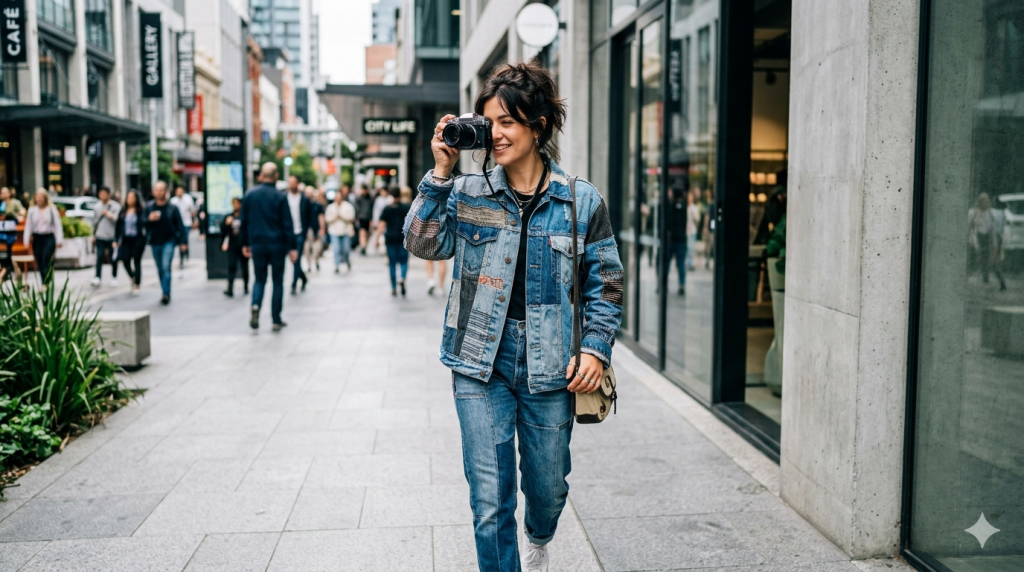
From a technical perspective, the power of reworked denim lies in its architectural unpredictability. In the world of street style, we are moving away from the “clean girl” aesthetic toward a more rugged, storied maximalism. When I style a subject in a jacket constructed from three different eras of Levi’s, the camera picks up a narrative of light and shadow that a flat fabric simply can’t replicate. The fringe, the frayed hems, and the erratic patchwork act as built-in leading lines, drawing the viewer’s eye across the frame and making the subject pop against even the most chaotic urban backdrops.
Furthermore, 2026 is the year of the “anti-algorithm” look. Social media is saturated with mass-produced silhouettes, making the one-of-one nature of upcycled pieces a photographer’s best friend. I always tell my clients: if you want a photo to stop the scroll, you need a garment that looks like it has a history. Whether it’s kintsugi-style fabric repairs or oversized silhouettes birthed from deadstock scraps, these pieces photograph with an authenticity that resonates. It’s not just about wearing a pair of pants; it’s about wearing a sculpture that captures the grit and grace of the modern street.
The Visual Texture of Sustainability: Why Reconstructed Fabrics Pop on Camera
When I’m scouting for the perfect shot, I look for more than just a well-coordinated outfit; I look for a narrative that catches the light. Upcycled denim is a photographer’s dream because it abandons the flat, monochromatic uniformity of mass-produced garments in favor of a rugged, multidimensional grit. In street photography, “new” often looks sterile, but reconstructed denim—with its frayed hems, mismatched indigo washes, and exposed structural seams—provides an organic complexity that vibrates against the urban landscape.
I find that the camera reacts differently to these “scarred” fabrics. While a standard pair of jeans might disappear into the shadows of a concrete alley, the varying dye lots of a repurposed trucker jacket create a natural high-low contrast that mimics professional chiaroscuro. When I frame a subject wearing a piece built from three different vintage pairs, the lens picks up those distinct tonal shifts, adding a sense of depth and volume that doesn’t require post-production trickery. It’s about that raw, tactile edge; the frayed edges of a “reconstructed” seam catch the golden hour light, creating a halo effect that elevates a simple street snap into a high-fashion editorial.
From my perspective, sustainability isn’t just a moral choice—it’s a visual strategy. The irregular stitching and “frankenstein” aesthetics of upcycled pieces break up the silhouette, preventing the subject from looking like a flat shape against the background. Every patch and raw edge tells the sensor a different story about light absorption and reflection. When you’re shooting in the unpredictable lighting of the city, these textures ensure that the garment remains the focal point, providing a rich, cinematic grain that perfectly complements the “perfectly imperfect” vibe of modern street style.
Mastering the ‘Patchwork’ Palette: Color Blocking with Reclaimed Indigo
When I approach street photography involving upcycled denim, I view the garment not just as a piece of clothing, but as a living collage of textile history. To truly master the “patchwork” palette, you must treat reclaimed indigo as a gradient scale rather than a single color. My secret for a high-impact visual is to leverage the stark contrast between “raw” unwashed scraps and “acid-washed” vintage pieces; this creates a natural chiaroscuro effect that pops against urban backdrops like gray concrete or red brick.
I always advise creators to look for intentional asymmetry. When styling a patchwork jacket or denim trousers, I position the darkest indigo panels at the frame’s natural leading lines—usually along the outer seams or the shoulders—to provide structural definition. This prevents the “blob” effect often seen in amateur denim-on-denim looks. By mixing mid-wash blues with sun-bleached whites and deep midnight navy, I am essentially painting with texture. In the lens, these intersecting shades create a rhythmic movement that guides the viewer’s eye across the subject’s silhouette.
For a street-style shot that feels editorial rather than chaotic, I balance the reclaimed indigo with a “grounding” element. If the patchwork is particularly busy, I’ll style it with a monochromatic base—perhaps a crisp white tee or a black turtleneck—to let the indigo spectrum breathe. Remember, the beauty of upcycled denim lies in its fringed edges and visible topstitching. I make sure these details are caught in the “golden hour” light, as the warmth of the sun makes the varying blue tones vibrate with a depth that brand-new denim simply cannot replicate.
High-Contrast Compositions: Pairing Dark Wash Scraps with Raw Edge Details
When I’m scouting for that perfect street style shot, I look for textures that narrate a story of reconstruction. To create a visual punch that demands attention through a lens, I swear by the deliberate juxtaposition of midnight-ink dark wash scraps against the rebellious, tactile energy of bleached raw edge details. This isn’t just about wearing old jeans; it’s about architectural contrast.
I recommend layering deep indigo patches onto a base of distressed light-wash denim. The sharp, vertical lines of “frayed-out” white threads act as a natural highlight, framing the darker panels and giving the garment a three-dimensional depth that pops against urban backdrops. In high-noon sun or under harsh neon lights, these raw edges catch the light, while the dark wash absorbs it, creating a dynamic chiaroscuro effect right on the body.
To master this look for the camera, I often lean into the “unfinished” aesthetic. I’ll pair a structured, multi-tonal upcycled corset with oversized trousers where the hem is left completely unraveled. The key is to let those rogue threads flow; they add motion blur and organic movement to a still photograph, breaking the static nature of traditional denim. When you contrast the “clean” darkness of raw denim scraps with the “chaos” of a feathered edge, you aren’t just wearing a trend—you’re wearing a focal point.
Structural Silhouettes: Using Asymmetrical Upcycled Jeans to Create Leading Lines
I approach upcycled denim not just as clothing, but as a deliberate architectural tool for the lens. When I’m styling asymmetrical pieces for a street shoot, I’m looking for those jagged, reconstructed hems and offset waistbands to act as literal pointers within the frame. By choosing jeans where one leg features a dramatic vertical patch or a diagonal seam-shift, I am effectively creating “leading lines” that draw the viewer’s eye toward the subject’s footwear or a specific vanishing point in the urban environment.
To truly master this look, I focus on the tension between the garment and the city’s geometry. If I’m shooting against a minimalist concrete backdrop, I’ll opt for a pair of jeans with exaggerated, multi-tonal denim panels sewn at 45-degree angles. This creates a sense of motion even when the subject is static. I often pair these structural silhouettes with a sleek, tucked-in bodysuit or a cropped technical jacket to ensure the focus remains on the distorted proportions of the lower body.
When I frame the shot, I align the sharpest angle of the denim—perhaps a reconstructed flare or a stepped hemline—with the natural shadows of the street. This technique, which I call “Structural Flow,” ensures that the upcycled nature of the fabric isn’t just a sustainability statement, but a compositional powerhouse. I always tell my clients: don’t just wear the denim; let its geometry dictate the path of the photograph.

The beauty of asymmetrical upcycling lies in its unpredictability. In a medium as fast-paced as street photography, these irregular silhouettes break the standard human outline, forcing the observer to pause and trace the lines. It’s about transforming “discarded” material into a high-fashion compass.
Wide-Leg Reconstructions and the ‘Movement’ Shot: Capturing Fluidity in Heavy Denim
When I look at a pair of upcycled wide-leg jeans, I don’t just see denim; I see a structural masterpiece of shifting weights and panels. To capture the true essence of these reconstructions in street photography, you have to lean into the inherent “heaviness” of the fabric. My secret to a perfect shot is mastering the kinetic silhouette. Because these pieces are often stitched together from multiple vintage pairs, the way they break at the knee and flare at the hem creates a unique architectural volume that only reveals itself when the subject is in motion.
I always advise my subjects to exaggerate their stride. When you take a long, purposeful step, the stiff, reclaimed denim resists the wind just enough to hold its shape, creating a dramatic “A-line” freeze frame. I look for the moment when the hem kicks out, revealing the internal patchwork or the raw, frayed edges that tell the story of the garment’s past life. This isn’t about a delicate flutter; it’s about the industrial swing of heavy cotton.
To maximize the visual impact, I focus on two specific styling maneuvers:
- The High-Low Contrast: Pair the massive volume of the reconstructed legs with a skin-tight base layer. This visual “pinch” at the waist emphasizes the sheer scale of the denim as it cascades toward the pavement.
- Hardware Highlights: I look for pieces with exposed side-seam zippers or mismatched metal rivets. In a movement shot, these metallic details catch the natural light, adding a sense of grit and “luxury-distress” to the frame.
From a technical perspective, I prefer a lower camera angle—shooting from the hip or lower—to elongate the legs and make the upcycled panels feel monumental. By catching the subject mid-pivot, the denim wraps around the legs in asymmetrical folds, proving that even the most rigid, sustainable materials can possess a fluid, high-fashion energy when framed through a street-style lens.
Texture Layering 101: Mixing Frayed Hems with Urban Architecture Backgrounds
When I approach a street shoot involving upcycled denim, I treat the frayed hem not just as a finishing touch, but as a deliberate architectural element. To master texture layering, I start by positioning the subject against the raw, uncompromising surfaces of the city—think weathered concrete, rusted corrugated metal, or exposed red brick. The “disturbance” in the fabric, specifically those loose threads and distressed fibers, creates a visual bridge between the organic softness of the garment and the rigid geometry of urban design.
I always advise layering a crisp, structured piece—like a heavy-gauge cotton trench or a sharp-shouldered blazer—over the reworked denim. This juxtaposition is key: the clean lines of the outerwear emphasize the chaotic beauty of the frayed edges. In street photography, these micro-textures catch the “golden hour” light or the harsh glow of neon, providing a tactile depth that flat, factory-new denim simply can’t replicate. It’s about creating a conversation between the “decay” of the hem and the grit of the sidewalk.
For the most impactful shot, I focus on the interplay of scales. If you’re shooting in front of a massive, minimalist glass facade, the intricate detail of a patchwork denim seam becomes the focal point of the frame. I love to play with movement here; as the subject walks, those unraveled threads catch the air, adding a sense of kinetic energy that mirrors the restless pulse of the city. Remember, we aren’t just styling an outfit; we are curating a sensory experience where the garment feels like a natural extension of the landscape.
The ‘Frankenstein’ Aesthetic: Balancing Busy DIY Textures with Minimalist Street Settings
When I’m styling these “Frankenstein” denim pieces—those glorious, chaotic hybrids of raw hems, mismatched washes, and exposed structural stitching—I treat the garment as a piece of maximalist sculpture. The mistake most people make is trying to compete with the jacket or jeans. In street photography, if your outfit is screaming and your background is shouting, the viewer’s eye has nowhere to land. My golden rule? Let the DIY texture be the protagonist while the architecture plays the silent supporting role.
I gravitate toward minimalist street settings to create a high-contrast visual tension. Think of a slab of brutalist concrete, a monochromatic metal shutter, or the stark, clean lines of a glass-fronted gallery. When I position a subject wearing heavy, multi-tonal upcycled denim against these “quiet” surfaces, the complexity of the fabric literally pops off the screen. I often look for neutral palettes—cool greys, muted beiges, or flat blacks—that won’t clash with the varying blue indigos of the denim patches.
To ground the look, I keep the rest of the styling surgically precise. If the jeans are a riot of frayed edges and overlapping pockets, I’ll pair them with a razor-sharp, tight-knit turtleneck or a crisp white tee. This creates a visual “anchor.” In the lens, this balance translates to a deliberate fashion statement rather than a messy accident. I want the camera to capture the intentionality of the craft; by stripping away the noise of the surroundings, the intricate needlework and the soul of the upcycled denim finally get the focus they deserve.