
Unlocking Affordable Spring Fashion Trends for Petite Women
Spring fashion often feels like a playground for the tall, but the industry is finally hitting a tipping point where petite-specific tailoring is no longer a luxury upcharge. As someone who has analyzed runway-to-retail cycles for years, I’ve seen the “petite” section evolve from an afterthought of shortened hems to a sophisticated science of adjusted rise, narrowed shoulders, and scaled-down hardware. This season, the “affordable” aspect is driven by a surge in high-street brands utilizing 3D pattern-cutting technology, which allows them to offer precise proportions without the bespoke price tag.
When we look at the 2026 spring forecast, the primary shift for shorter frames is the rejection of “oversized” chaos. We are moving toward “fluid structure.” This means you can embrace the airy vibes of spring without getting swallowed by fabric. The secret to mastering these trends on a budget lies in identifying “expensive-looking” details that naturally favor smaller frames:
- Verticality via Texture: Ribbed knits and plissé fabrics are everywhere this spring. For us, these aren’t just style choices; they are functional tools that create unbroken vertical lines, tricking the eye into seeing extra inches of height.
- The “Third Rule” Logic: The most successful budget collections this year are leaning into the 1/3 to 2/3 ratio. Instead of the traditional half-and-half split that cuts a petite torso in two, we’re seeing a massive influx of cropped silhouettes paired with high-rise bottoms.
- Strategic Transparency: Sheer paneling and organza overlays are trending. For a petite woman, a sheer hem on a midi skirt allows the leg line to be visible while still participating in the longer-length trend, preventing the “stumpy” look that opaque heavy fabrics often create.
The real insider tip for this season? Focus on monochromatic layering in lightweight textiles like Tencel and linen blends. Many affordable retailers are releasing “co-ord” sets. Buying these is a strategic win; wearing a single color from shoulder to toe removes the visual breaks that usually truncate a petite silhouette. I’ve observed that the current market is saturated with “soft utility” styles—think cargo pants without the bulk—which offer the perfect balance of trend-relevance and functional scale for those of us under 5’4″.
Investing in spring trends shouldn’t mean a complete wardrobe overhaul. It’s about selecting pieces that respect the golden ratio of petite dressing: keeping the focus on the waist and ensuring that necklines and cuffs don’t overwhelm your natural frame. By prioritizing these specific construction elements over fleeting fast-fashion gimmicks, you can build a high-end aesthetic on a surprisingly lean budget.
Top Spring Silhouettes That Flatter Petite Frames on a Budget
The secret to dressing a petite frame isn’t about shrinking your style; it’s about mastering proportion through strategic silhouettes. When working with clients 5’4″ and under, I always prioritize architectural lines that create an unbroken vertical visual, especially when we’re styling on a strict spring budget. You don’t need bespoke tailoring to achieve this. Many accessible brands have significantly improved their structural cuts this season, allowing us to build a high-end look using high-street pieces. The goal is to apply the “rule of thirds”—avoiding outfits that visually cut the body in half (1:1 ratio) and instead aiming for a 1:2 or 2:1 ratio to naturally elongate the figure.
| Standard Spring Silhouette | The Petite Upgrade | Budget-Friendly Fabric Pick |
|---|---|---|
| Mid-Rise Chinos | High-Waisted Wide-Leg Trousers | Viscose or Lyocell Blends |
| Standard Hip-Length Cardigan | Cropped Ribbed Knit or Boxy Jacket | Textured Cotton Knit |
| Tiered Maxi Dress | Tailored A-line Midi Dress | Poplin or Crepe |
High-Waisted Wide-Leg Trousers: Lengthening Your Legs
Forget the outdated styling myth that wide-leg pants swallow shorter frames. A true high-waist trouser is one of our most powerful tools because it shifts the visual waistline upward, instantly adding perceived inches to your legs. For spring, we are trading heavy winter wools for lighter, draped fabrics. Fast-fashion retailers excel at producing viscose-linen blends and Tencel options that mimic the flow of expensive silk without the designer price tag.
- The Fit Check: Ensure the pants fit snugly and smoothly through the waist, hips, and upper thighs before flaring out. Any excess bagging at the hips will add unwanted horizontal width.
- The Hem Hack: Buy regular-length wide-leg trousers from budget stores and use iron-on hemming tape. This DIY tailoring trick saves you a $20 alteration fee and lets you customize the length perfectly to your favorite affordable spring wedges or platform sneakers.
Cropped Jackets and Cardigans: Perfecting Proportions
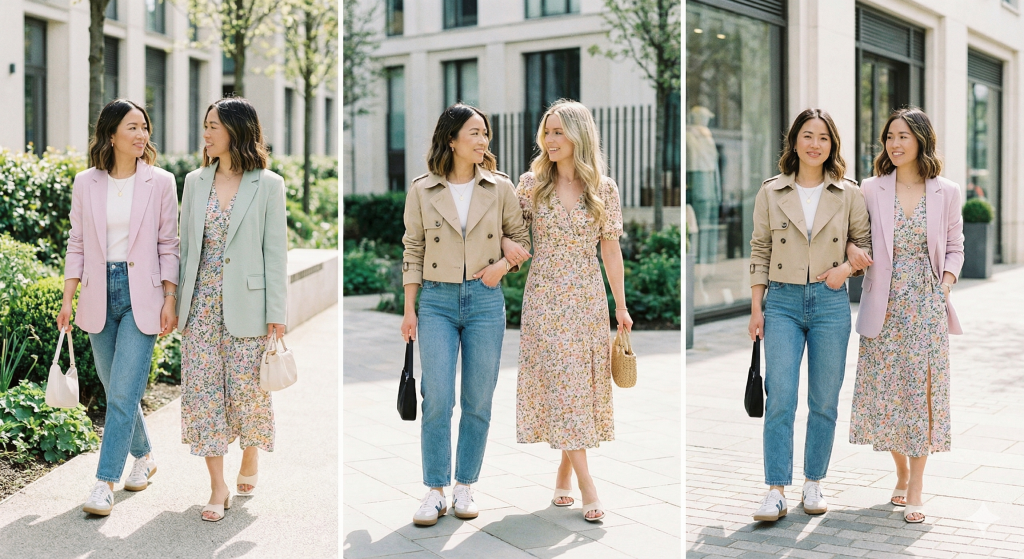
Standard-length blazers and lightweight jackets often hit right at the widest part of the hips, cutting a petite figure exactly in half and dragging the torso down. By swapping standard outerwear for cropped spring jackets—think classic denim, lightweight boucle, or ribbed knit cardigans—we instantly draw the eye up. A hem that hits right at the natural waist or slightly above is non-negotiable for maintaining that 1:2 proportion.
- Affordable Sourcing: I frequently advise my clients to check the “tweens” or older kids’ sections in major department stores. You can often find high-quality, perfectly cropped denim jackets or spring trench coats for half the price of the adult women’s section.
- Styling Execution: Leave the jacket open over a fitted, tucked-in tank top. This creates a vertical “column of color” underneath, which acts as an optical illusion for height.
Tailored Midi Dresses: The Essential Spring Staple
The midi dress often intimidates petite shoppers, but avoiding it means missing out on one of spring’s most elegant, cost-effective throw-and-go outfits. A single dress is cheaper than buying a top-and-bottom combo. The tailored midi works exceptionally well for us, provided the waist is sharply defined and the skirt doesn’t carry excess, gathered volume (like heavy tiered ruffles).
The sweet spot for a petite midi hemline is either just right below the knee or exactly at mid-calf—never hitting right at the ankle bone, which reads as a maxi dress that shrank in the wash. Look for wrap dresses or bias-cut slips in budget-friendly crepe materials. These fabrics skim the body rather than standing stiffly away from it. When you pair a cleanly structured midi with a sharply pointed-toe mule or a low-vamp flat, you guarantee a seamless, elongated profile that looks incredibly expensive on a minimal budget.
High-Waisted Wide-Leg Trousers: Lengthening Your Legs
The magic of a high rise combined with a sweeping wide leg is arguably the most powerful optical illusion in a petite woman’s style arsenal. I consistently see clients under 5’4″ shy away from volume on the bottom, fearing it will swallow them whole. In reality, when executed correctly, high-waisted wide-leg trousers anchor the frame and artificially raise the natural waistline, instantly adding inches to the appearance of your legs.
To master this look without draining your spring wardrobe budget, you do not need designer labels; you need strategic tailoring and a keen eye for proportions. Here are the exact specifications I look for when sourcing affordable options for my petite clients:
- The Optimal Rise: For petite frames, a rise between 10.5 to 12 inches is the sweet spot. Anything lower chops the torso awkwardly, while an overly high rise can consume a short torso.
- The Inseam Formula: Look for petite-specific inseams ranging from 27 to 29 inches. If you find a budget-friendly standard size with the perfect drape at a high-street retailer, factor a quick $15 trip to the tailor into the cost—it is non-negotiable for achieving that essential floor-skimming length.
- Fabric Weight: Spring demands movement. I highly recommend lightweight linen blends, viscose, or drapey crepe. Stiff, heavy fabrics create a boxy silhouette, whereas fluid fabrics pull the eye downward, naturally enhancing the vertical line.
When styling these trousers, the “rule of thirds” is your best friend. Breaking your body into a 1/3 top and 2/3 bottom ratio visually elongates the lower half. I achieve this by pairing these trousers with fitted, tucked-in tops or precisely cut cropped jackets that hit right at the waistband.
| Shoe Pairing | The Visual Effect | Spring Footwear Match |
|---|---|---|
| Pointed Toe | Extends the leg line seamlessly past the wide hem of the trouser. | Nude pointed-toe mules or classic slingbacks. |
| Platform/Chunky Sole | Adds literal height while keeping the sweeping hem off the ground. | Chunky white leather fashion sneakers. |
| Low Block Heel | Provides subtle elevation without compromising daytime comfort. | Open-toe strappy block sandals. |
The hem of the trouser should fall exactly half an inch above the floor when wearing your chosen shoes. This unbroken, continuous line from the high waist down to the pavement is the definitive trick to maximizing your height through styling alone.
Cropped Jackets and Cardigans: Perfecting Proportions
The secret weapon in my petite styling arsenal isn’t a magical pair of heels; it’s the hemline of your outerwear. When we talk about perfecting proportions for frames under 5’4″, cropped jackets and cardigans do the heavy lifting by visually raising your natural waistline. If you throw a standard-length blazer over your outfit, it cuts your body directly in half. This 1:1 ratio drags the eye down. By swapping that out for a cropped layer, you instantly achieve the coveted “rule of thirds”—creating a 1/3 top to 2/3 bottom ratio that dramatically elongates your legs, especially when paired with those high-waisted trousers we just covered.
For this spring, you don’t need to spend designer prices to nail this structural shift. Budget retailers have heavily adopted cropped silhouettes, but the trick is knowing exactly which fabrics and cuts to look for so the piece actually looks expensive.
- The Cropped Trench: Traditional duster trenches can easily swallow a petite frame. A cropped trench—hitting right at the hip bone—delivers that classic spring aesthetic without the overwhelming yardage of fabric. Look for stiff cotton-twill blends; physical structure is what makes a budget jacket mimic high-end tailoring.
- The Boxy, Raw-Hem Denim: Skip the oversized 90s trucker jackets this season. A boxy, cropped denim jacket is the perfect lightweight layer. My favorite insider hack: Buy a standard, affordable denim jacket from a thrift store or discount retailer, grab a pair of fabric scissors, and chop it straight across your natural waist. The raw, frayed hem is incredibly trendy for spring, and the custom tailored length costs you absolutely nothing.
- Fine-Knit Cardigans as Tops: Ditch the chunky cardigans that add visual weight. Lightweight, ribbed knit cardigans that hit exactly at the belly button are serving double duty right now. Worn fully buttoned as a standalone top, they eliminate the need for tucking, which saves petite frames from dealing with awkward fabric bulk around the midsection.
Finding your exact cropped sweet spot depends entirely on your specific proportions. Use this quick reference guide the next time you are hitting the fitting rooms or adding items to your online cart:
| Petite Body Type | Ideal Cropped Hemline | Why It Works |
|---|---|---|
| Short Torso / Long Legs | Just below the hip bone | Prevents the torso from looking completely non-existent while maintaining the existing leg line. |
| Long Torso / Short Legs | Directly at the natural waist (the narrowest part) | Provides maximum leg elongation by drawing the eye aggressively upward. |
| Balanced Proportions | Top of the high-waisted waistband | Creates a seamless, continuous visual line from the jacket hem straight into the trousers. |
Always check the shoulder seams when shopping budget brands. A cropped jacket will only flatter a petite frame if the shoulder seam sits precisely where your natural shoulder ends. If it droops, the tailoring illusion shatters, and even the most perfectly cropped length will just look like you bought the wrong size.
Tailored Midi Dresses: The Essential Spring Staple
Forget the outdated fashion myth that petite women cannot wear midi lengths; a precisely cut midi dress is arguably the most powerful weapon in your spring arsenal. The secret lies not just in the fabric, but in the strict adherence to proportion. When styling petite clients, I consistently rely on midis to create an unbroken vertical line that elongates the body without the overwhelming volume that often comes with full maxi lengths.
The term “tailored” does not mean you have to factor expensive seamstress visits into your budget. Instead, I recommend hunting for smart, off-the-rack design details that mimic a custom fit. Pieces with adjustable tie waists, smocked back panels, or customizable shoulder straps are essential. These elements allow you to cinch the garment exactly at your natural waistline, which for us is usually higher than where standard sizing places it.
Hemline placement makes or breaks this look for a shorter frame. Your spring midi must hit either just below the knee or lower down at the narrowest part of your ankle. If the hem stops right at the widest part of your calf muscle, it visually chops your leg in half and instantly subtracts inches from your height. To guarantee a flawless fit straight off the rack, keep an eye out for these specific silhouettes:
| Midi Silhouette | Why It Works for Petites | Budget Buying Tip |
|---|---|---|
| The True Wrap Dress | The V-neckline draws the eye vertically, while the wrap waist guarantees a perfect cinch regardless of your specific torso length. | Avoid faux-wraps with rigid elastic waists; look for functional ties to control the fit yourself. |
| The Bias-Cut Slip | Bias cuts skim the body’s natural curves rather than hanging like a box, preventing excess fabric from swallowing a small frame. | Prioritize styles with adjustable spaghetti straps to easily fix armhole gaping without sewing. |
| Square-Neck A-Line | A square neckline opens up the décolletage, bringing attention up to the face, while a gentle A-line prevents bottom-heavy bulk. | Check budget petite sections specifically for this cut so the horizontal waist seam hits properly. |
One of my favorite insider tricks for making an affordable midi look expensive is focusing on the slit. A dress with a strategic side or front slit allows for movement and shows a flash of leg as you walk. This simple design detail breaks up the solid block of fabric and immediately adds the illusion of extra height. Keep the visual weight light by pairing these dresses with low-vamp flats or pointed-toe slingbacks, intentionally avoiding heavy, chunky footwear that visually anchors you down.
Must-Have Spring Colors and Prints to Elevate Your Look
Color and pattern are the secret weapons in a petite wardrobe, acting as optical illusions that can instantly add visual height or, conversely, swallow a smaller frame. When pulling spring looks for clients under 5’4″, I prioritize a strategic palette that maximizes vertical lines while strictly keeping the budget in check. Fast-fashion retailers constantly churn out runway-inspired hues, but the insider secret is knowing exactly which shades and patterns look inherently expensive, even on a $30 poly-blend.
Pastel Monochromes for a Taller Illusion
Monochromatic dressing is my non-negotiable styling rule for elongating a petite figure. It actively removes the harsh horizontal visual breaks that chop up your body at the waist or hips. For spring, we drop the heavy winter blacks and pivot to pastel monochromes. Think head-to-toe buttery yellow, powdery blue, or soft lavender.
When you wear a single, continuous light shade, the eye travels vertically without interruption. Here is where the budget hack comes in: pastel tones are incredibly forgiving on cheaper materials. Affordable fabrics in soft, muted tones easily mimic the drape and finish of luxury silks or lightweight wools, whereas highly saturated neons or stark whites often highlight cheap stitching and thin materials.
- The matching set hack: High-street brands are goldmines for affordable spring co-ords. Buying a matching pastel linen-blend vest and trouser set guarantees an instant, budget-friendly monochrome column.
- Shoe continuity: Carry the monochrome line down to your toes. A nude or color-matched pointed-toe slingback extends the leg line significantly more than a contrasting chunky sneaker.
Micro-Florals vs. Large Prints: What Works Best for Petites
The scale of your print must strictly mirror the scale of your frame. Every spring, I see petite women drown in trendy, oversized botanical prints. Massive patterns create a heavy visual anchor, dragging the eye down and making the wearer appear wider and shorter.
Your go-to search terms when shopping online should be “ditsy floral,” “micro-check,” or “pin-dot.” The general rule of thumb I use during fittings is simple: if a single motif within the print is larger than your closed fist, it belongs back on the rack.
| Print Style | Petite Verdict | Visual Effect on Small Frames |
|---|---|---|
| Ditsy/Micro-Florals | Highly Recommended | Reads as a textured solid from afar; maintains bodily proportions without overwhelming the wearer. |
| Large Scale Botanicals | Avoid | Swallows the silhouette; draws attention horizontally rather than vertically. |
| Pinstripes/Thin Verticals | Highly Recommended | Forces the eye up and down, successfully faking inches of height. |
| Thick Horizontal Stripes | Avoid | Widens the body, cuts off vertical flow, and ruins the elongating effect of tailored fits. |
By filtering your seasonal shopping through this strict lens of scale and color continuity, you force every inexpensive garment to work mathematically in your favor, elevating both your height and the perceived value of your spring wardrobe.
Pastel Monochromes for a Taller Illusion
Dressing head-to-toe in a single color is one of the oldest stylist tricks in the book for elongating a petite frame, but spring calls for a departure from the heavy blacks and navies of winter. This season, I am steering my clients straight toward pastel monochromes. When you wear the same soft hue—whether it is an icy lavender, butter yellow, or pistachio green—from your neckline down to your hem, you create a continuous, unbroken vertical line. The eye travels seamlessly up and down your silhouette, completely avoiding the “chopped up” effect that highly contrasting tops and bottoms often create on those of us under 5’4″.
The secret to making an affordable pastel outfit look expensive and intentional lies strictly in texture blocking. Because you are not relying on color contrast, you need tactile contrast to prevent the outfit from looking flat or juvenile. I always recommend pairing a glossy, budget-friendly satin slip skirt with a chunky ribbed cotton sweater in the exact same shade of powder blue. This mix of light-catching and light-absorbing fabrics adds architectural depth to the look and effortlessly masks the lower quality of high-street fabrics.
To master this elongating illusion on a budget, keep these styling directives in mind:
- Embrace Tonal Variations: Do not stress over finding exact dye lots, which is nearly impossible when mixing separates from different affordable retailers. Pairing a slightly warmer blush pink blouse with a cooler petal pink trouser actually adds sophisticated dimension while maintaining the elongating visual column.
- Match Your Footwear: I constantly remind petite women to carry their chosen pastel down to their shoes. If you cannot find a matching lilac or mint shoe, a pointed-toe nude pump or mule is the best alternative to keep the leg line extending downward without visual interruption.
- Ditch the Contrasting Belts: Let the color block do the heavy lifting. Wrapping a dark or highly contrasting belt around your waist instantly slices the body in half, completely ruining the tall illusion we just built with the pastel palette. If you must belt to define your waist, use a self-tying fabric belt in the identical shade.
Micro-Florals vs. Large Prints: What Works Best for Petites
Every spring, I see petite clients gravitate toward massive, sweeping botanical prints on the racks, only to feel completely swallowed whole once they hit the fitting room. The scale of your pattern dictates the perceived scale of your body. When you stand at 5’4″ or under, a sprawling sunflower motif fights against your natural proportions, drawing the eye side-to-side rather than up and down. The goal is to wear the print, not let the print wear you.
Micro-florals—often called ditsy prints—are a petite woman’s secret weapon. Because the individual elements are tiny, the pattern reads almost like a solid texture from a distance. This continuous visual flow prevents the body from being chopped into awkward horizontal segments. As an industry insider, I will let you in on a budget-shopping secret: fast-fashion retailers rarely take the time to pattern-match at the seams. A mismatched large floral print instantly betrays a cheap price tag. However, a dense micro-floral disguises those very same seam lines beautifully, making an affordable wrap dress look remarkably high-end.
I never tell my clients to banish large prints entirely, but they require strict strategic placement. If you absolutely love a bold, oversized print, anchor it on your lower half—like a flowy midi skirt—and pair it with a solid, fitted top to maintain the elevated waistline we established in the silhouette guidelines. The true make-or-break factor with large prints is negative space. A large print packed tightly together is visually suffocating on a short frame; a large print with plenty of solid background color allows the eye to rest and maintains your vertical line.
| Print Type | Visual Impact on Petites | Budget Shopping Advantage |
|---|---|---|
| Micro-Florals / Ditsy | Creates a continuous, elongating texture. Does not overwhelm the frame. | Hides cheap, unmatched seams and tailoring flaws easily. |
| Large / Bold Prints | Draws the eye horizontally. Can make the wearer appear shorter and wider. | Highlights poor pattern-matching, often looking cheaper than it is. |
When you are navigating the spring racks this season, keep my three hard-and-fast rules for petite print selection in mind:
- The “Fist” Rule: Hold your closed hand against the garment. If a single flower or pattern element is larger than your fist, it is too big for your frame and will disrupt your proportions.
- Vertical Vining: Look for prints, whether floral or abstract, that cascade or vine downwards rather than spreading horizontally across the fabric. This naturally guides the observer’s eye vertically.
- Harmonious Contrast: Instead of stark, high-contrast prints (like bright white daisies on a pitch-black background), opt for low-contrast prints that utilize the soft spring color palettes we explored earlier. Low contrast ensures the pattern blends smoothly, preventing abrupt visual breaks that cut your height.
Where to Shop for Budget-Friendly Petite Spring Collections
Finding brands that actually tailor their inseams and armholes for frames under 5’4″ without draining your wallet requires insider knowledge. I’ve spent years styling petite clients, and the high-street market has finally evolved past simply chopping a few inches off standard hems. You need retailers that physically adjust the torso length, knee placement, and shoulder widths to ensure those wide-leg trousers and cropped jackets we just discussed fit perfectly right off the rack.
My trusted, budget-friendly petite styling rolodex relies heavily on brands that prioritize proportional scaling. Here are the mainstays I consistently pull from for spring collections:
- ASOS Petite: This is my primary destination for trend-heavy spring pieces. They scale down everything proportionately rather than just shortening the legs. If you are looking for those tailored midi dresses in pastel monochromes, ASOS consistently delivers. Fit tip: Their sizing can run slightly narrow in the waist, so I always advise clients to size up if they are between sizes, especially for structured bottoms.
- Abercrombie & Fitch: Following a massive brand overhaul, they have emerged as a petite denim and trouser powerhouse. They offer “Short” and “Extra Short” inseams across nearly all their bottoms. While slightly pricier than fast fashion, their seasonal sales drop prices into the highly affordable tier. Their high-waisted tailored pants are practically a spring uniform for my petite clients.
- Uniqlo: While they don’t label a massive dedicated “petite” line, they are an essential secret weapon for spring basics because of one specific perk: cheap or free custom hemming. You can buy their lightweight spring trousers and have them hemmed to your exact inseam before they even ship. Additionally, their cropped cardigans are naturally cut shorter, hitting right at the natural waist of a petite frame without any bunching.
- Old Navy: For budget-friendly micro-floral prints and casual spring layers, Old Navy’s online-exclusive petite section is exceptional. They take the time to adjust the rise on their jeans and the armhole depth on their sleeveless spring tops, preventing that dreaded bra-peek effect.
To make your shopping easier, I have compiled a quick reference matrix based on my seasonal pulls:
| Retailer | Best Spring Buy | Price Point | Expert Fit Note |
|---|---|---|---|
| ASOS Petite | Midi Dresses & Trend Jackets | $ – $$ | Watch the waist sizing; structure often runs narrow. |
| Abercrombie | Tailored Trousers & Denim | $$ | Opt for “Extra Short” if you are under 5’1″. |
| Uniqlo | Cropped Knits & Basics | </td> <td style="padding: 12px;">Utilize their custom alteration service for perfect trouser breaks.</td> </tr> <tr> <td style="padding: 12px;"><strong>Old Navy</strong></td> <td style="padding: 12px;">Printed Casuals & Skirts</td> <td style="padding: 12px;"> |
Online only; torso lengths are genuinely shortened. |
When navigating these sites, I immediately filter by “Petite” before browsing to avoid the heartbreak of falling for a piece that will ultimately swallow your frame. I also always check the fabric composition—lightweight spring fabrics like linen and viscose shrink slightly after the first wash. I factor a quarter-inch of shrinkage into my fit evaluation when having clients try on new spring pieces at home.
Expert Styling Hacks to Maximize Your Petite Spring Wardrobe
I always tell my petite clients that buying the right spring pieces is only half the battle; how you style them determines whether you look swallowed in fabric or effortlessly elongated. The secret to maximizing a budget-friendly wardrobe lies in visual manipulation, using styling hacks that cost absolutely nothing to execute.
My absolute non-negotiable styling rule for frames under 5’4″ is the Rule of Thirds. If you divide your body into three equal sections from shoulders to toes, your outfit proportions should never cut you in half (the dreaded 1/2 and 1/2 ratio). When styling those high-waisted trousers or midi dresses we discussed earlier, ensure your top occupies the top third of your visual silhouette, leaving the bottom two-thirds for your legs. A simple French tuck or utilizing a cropped cardigan instantly achieves this 1/3 to 2/3 golden ratio, tricking the eye into perceiving a much taller frame.
Let’s talk about the visual anchor of your spring outfits: footwear. We often overlook how heavily shoes impact our vertical line. When wearing skirts, shorts, or cropped denim, I swear by the “nude-to-you” footwear strategy. Opting for a sandal or flat that closely matches your skin tone prevents a harsh visual break at the ankle. If you are wearing full-length spring trousers, match your shoe color to the hem of the pants. This creates an unbroken, continuous line from your waist straight down to the floor.
To refine your silhouette even further, keep these micro-adjustments in your daily rotation:
- Micro-Belting: Thick belts swallow petite torsos. Swap them out for micro-belts (under one inch in width). You still define the waist without sacrificing precious vertical torso space.
- Sleeve Pushing: Exposing your wrists and forearms draws the eye upward and prevents oversized spring blouses from drowning your frame. Simply push your sleeves up to the elbows—use clear hair ties hidden under the fabric fold if they keep slipping down.
- The V-Neck Illusion: When layering your spring tops, unbuttoning an extra button to create a deeper V-neck elongates the neck and draws focus directly to the center of your body.
As fashion insiders, we know the actual secret to making affordable clothing look bespoke is strategic tailoring. You do not need to alter every single fast-fashion purchase, but investing a few dollars into specific adjustments yields a massive return on investment. Here is my breakdown of where to allocate your alteration budget for maximum impact:
| Clothing Item | The Common Petite Issue | The High-Impact Tailoring Fix (Avg. Cost) |
|---|---|---|
| Wide-Leg Spring Trousers | Puddling fabric that drags, widens the stance, and ruins the drape. | A simple hem to exactly 1/4 inch above the floor while wearing your go-to spring shoes. ($10 – $15) |
| Lightweight Spring Blazers | Shoulder seams drooping down the arm, making the garment look sloppy and cheap. | Taking up the shoulder seam to sit exactly at the natural shoulder bone. ($20 – $30) |
| Midi Dresses & Skirts | Hitting exactly at the thickest part of the calf, stunting the leg line. | Raising the hemline to sit just below the knee or right at the narrowest part of the ankle. ($15 – $20) |
FAQ
Q: Should I strictly stick to “Petite” sections, or can I shop regular sizing on a budget?
I’ve spent years in fitting rooms, and my honest take is that you shouldn’t limit yourself to the petite rack, especially since those specialized lines are often priced higher or excluded from sales. You can absolutely score gems in the regular department if you know what to look for: 7/8 length leggings become full-length on us, cropped tops sit perfectly at our natural waistline, and bracelet-length sleeves usually hit right at the wrist. However, for tailored items like blazers or trousers with complex knee-positioning, investing in a petite-specific cut saves you a fortune in tailoring costs later.
Q: Are horizontal stripes really a “no-go” for shorter frames this spring?
That’s an outdated “rule” we need to retire. The secret isn’t avoiding stripes; it’s managing the scale and contrast. A fine, thin Breton stripe in navy and white is a spring classic that won’t overwhelm a small frame. To keep the vertical line intact while wearing stripes, I always recommend layering a solid-colored unbuttoned cardigan or denim jacket over the top. This creates two vertical boundaries that draw the eye up and down, effectively neutralizing any “widening” effect of the horizontal pattern.
Q: How can I jump on the “oversized” trend without looking like I’m wearing a tent?
The “Big-Small” rule is your best friend here. If you’re opting for an oversized spring linen shirt, keep your bottom half streamlined with tucked-in straight-leg jeans or leggings. I also suggest the “Double Cuff” trick: roll up your sleeves to expose your forearms. Showing the thinnest part of your limbs provides a visual cue of your actual size, preventing the fabric from “swallowing” your silhouette.
Q: What is the most cost-effective way to update my petite wardrobe each season?
Instead of buying a whole new wardrobe, I focus on “The Third Piece” rule. Buy two or three budget-friendly, trend-forward accessories—like a skinny leather belt to cinch oversized dresses or a pair of pointed-toe mules in a nude shade. Pointed toes are a pro secret for extending the leg line by 1-2 inches visually. These small investments refresh your existing basics without the commitment of a high-price seasonal haul.
| Feature | Standard Fit (The Risk) | Petite/Proportionate Fix |
|---|---|---|
| Knee Position | Too low, creates “sagging” look | Aligned for natural movement |
| Shoulder Seams | Droop off the edge, looks sloppy | Sit exactly at the shoulder bone |
| Rise Depth | Too long, creates bunching at crotch | Contoured for shorter torsos |
Q: Is there a specific heel height that works best for spring outings?
You don’t need 4-inch stilettos to look taller. In fact, a 1.5 to 2-inch block heel or kitten heel is often more flattering for petites because it maintains a natural gait and doesn’t make the calf muscle look strained. For spring 2026, look for low-profile slingbacks. They offer the elevation you want while keeping the ankle exposed, which is essential for that leg-lengthening “continuous line” we’re after.