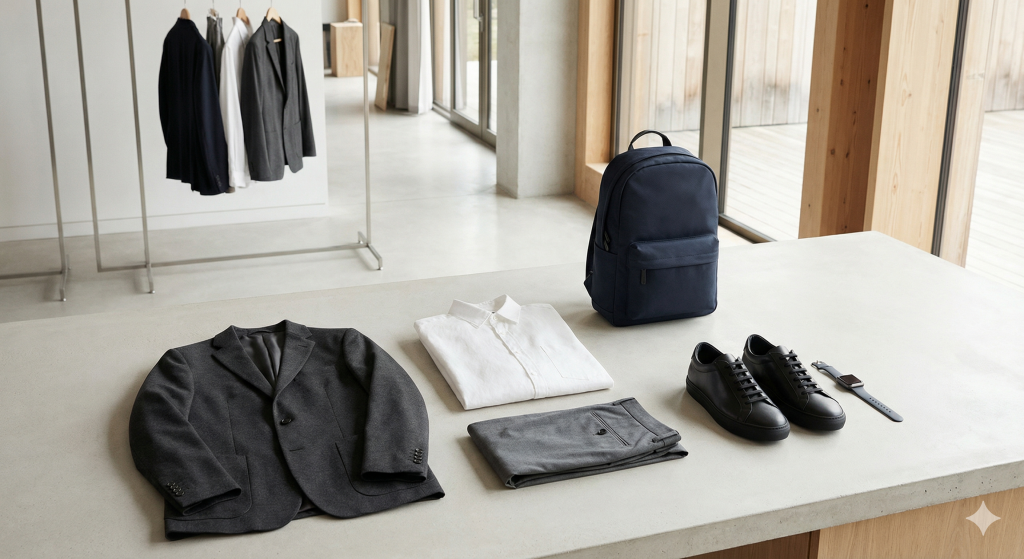

Why the Minimalist Capsule Wardrobe is the Future of Workwear
The era of the overflowing, chaotic closet is effectively dead in the professional sphere. In my years styling executives and analyzing macro fashion shifts, I have watched the traditional approach to workwear collapse under its own weight. We are moving away from trend-chasing office attire because today’s professionals simply do not have the bandwidth for decision fatigue before 8:00 AM. A minimalist capsule wardrobe is no longer a niche lifestyle choice; it has become a necessary operational strategy for the modern career.
Corporate dress codes have fundamentally changed. With hybrid schedules becoming the permanent reality for many industries, the rigid boundary between boardroom formal and weekend casual has blurred beyond recognition. I constantly hear from clients who feel their traditional corporate suits are too stiff, yet their relaxed wear lacks the polish required for high-stakes, on-camera meetings. The minimalist capsule bridges this gap flawlessly. By focusing on highly versatile, interchangeable pieces, we create an agile wardrobe capable of pivoting from a morning home-office strategy session to an afternoon in-person client pitch without missing a beat.
We also have to examine the brutal economics of modern clothing consumption. Fast fashion has deeply infiltrated workwear, leading to closets packed with low-quality garments that pill, fade, and lose their structural integrity after a handful of dry cleaning cycles. When you stand in front of fifty hangers but feel you have “nothing to wear,” you are experiencing the direct failure of reactive, impulse buying. The future of dressing for work relies entirely on the cost-per-wear metric and intentional investment.
| Wardrobe Metric | Traditional / Fast Fashion Approach | Minimalist Capsule Strategy |
|---|---|---|
| Morning Friction | High; averaging 15-20 minutes of outfit trial, error, and frustration. | Streamlined; under 3 minutes due to guaranteed item compatibility. |
| Lifecycle & ROI | Constant replacement cycle; cheap fabrics degrade quickly under wear. | Multi-year longevity; focus shifts to minor tailoring and maintenance of premium fabrics. |
| Personal Brand Image | Inconsistent; fluctuates wildly based on daily trend execution. | Highly consistent; establishes a recognizable, polished, and authoritative aesthetic. |
Beyond the financial and temporal logic, there is a profound psychological advantage to this approach. When you curate a highly edited selection of garments that fit flawlessly and coordinate effortlessly, you project an aura of control and refinement. You signal quiet competence. You are never distracted by a poorly tailored seam or a micro-trend that feels suddenly inappropriate when called into an impromptu meeting. My highest-performing clients treat their workwear exactly like their business strategies: optimized, entirely intentional, and aggressively stripped of all unnecessary friction.
Key Elements of a Modern Professional Minimalist Capsule
The anatomy of a modern workwear capsule relies entirely on the precise intersection of silhouette, textile, and tone. We are moving away from the rigid, multi-piece corporate uniforms of the past decade into an era of “soft tailoring.” To curate a rotation that performs seamlessly Monday through Friday, I always advise my private clients to focus heavily on the architectural foundation of their garments rather than sheer volume.
Essential Core Pieces: Blazers, Trousers, and Blouses
The foundational trio of any functional work wardrobe remains the same, but the cuts have dramatically shifted. The modern blazer must possess a relaxed, slightly oversized fit—think structured shoulders with a fluid drape through the torso. This allows for layering over chunky knits in winter or a simple silk camisole in summer. For trousers, the skinny leg is entirely obsolete in professional settings; we are leaning heavily into high-waisted, wide-leg, or pooling silhouettes that offer both movement and authority. Blouses should be treated as the softening element. I source bias-cut silk or high-quality viscose that skims the body, featuring subtle details like an asymmetrical neckline or exaggerated cuffs rather than loud, distracting prints.
Fabric Choices: Sustainability vs. Durability Matrix
A minimalist wardrobe is worn frequently, meaning the textile breakdown dictates the lifespan of your investment. You cannot compromise here. I use a specific matrix to evaluate fabrics for my clients, balancing eco-conscious sourcing with the hard-wearing reality of daily commuting and long office hours.
| Fabric Type | Sustainability Factor | Durability & Wearability | Best Used For |
|---|---|---|---|
| Tropical Wool | High (if RWS certified) | Excellent; naturally wrinkle-resistant and breathable. | Year-round blazers and trousers. |
| Tencel / Lyocell | Very High (closed-loop production) | Moderate; drapes beautifully but requires gentle washing. | Blouses and soft-tailored shirts. |
| Heavyweight Linen | High (requires less water than cotton) | High; softens with age, though prone to creasing. | Summer suiting and tailored vests. |
| Recycled Poly-Blends | Moderate (reduces landfill waste) | Extremely High; holds sharp pleats and resists fading. | Blended into wool for structured trousers. |
The Neutral Color Palette Strategy
Color theory in a professional capsule is about creating maximum combinations with minimal items. A stark black-and-white palette often reads too severe and lacks dimension. Instead, I build wardrobes around a “tonal neutral” strategy. This involves selecting one deep grounding shade—like midnight navy, charcoal, or rich espresso—and layering it with mid-tones such as camel, dove gray, or muted olive.
To implement this effectively, reserve your grounding shades for heavy investment pieces: the tailored blazer, the everyday trouser, and the structured tote. Use your mid-tones and lighter shades (cream, ivory, soft taupe) for blouses, light knitwear, and accessories. This creates a cohesive visual flow where every top mathematically matches every bottom. By eliminating harsh color contrasts, the eye naturally focuses on the quality of the fabrics and the precision of the tailoring, which is the exact hallmark of quiet luxury in the workplace.
Essential Core Pieces: Blazers, Trousers, and Blouses
The foundation of any functional workwear rotation rests entirely on the holy trinity of tailoring: the blazer, the trouser, and the blouse. In my years of styling executives and analyzing runway shifts, I have watched the definition of these pieces evolve dramatically. We are no longer dealing with stiff, restrictive boardroom armor. Today’s core items demand fluidity, multi-way styling, and impeccable drape, serving as the structural anchors for your entire weekday rotation.
The modern workwear blazer has abandoned the fitted, cropped silhouettes of the past. We are now grounding wardrobes with the relaxed-fit, lightly structured shoulder blazer. Look for a tropical wool or wool-crepe blend; it naturally resists wrinkling during commutes and transitions effortlessly from high-stakes client pitches to after-hours networking. I always advise my clients to invest in a single-breasted, mid-hip cut if they want maximum versatility. Taller frames can leverage the dramatic drape of an oversized double-breasted jacket, but the secret is in the sleeve—pushing them up slightly exposes the forearm, instantly breaking up the visual weight of the tailoring.
For trousers, the skinny ankle pant has been entirely phased out in favor of the wide-leg, high-waisted tailored pant. The hallmark of a perfect minimalist trouser lies in the front pleat and the pooling of the fabric. A single reverse pleat provides volume and movement without adding bulk at the waistline. When selecting this piece, pay strict attention to the break. The trouser hem should just graze the vamp of your footwear, offering a seamless line whether you pair them with a chunky leather loafer or a pointed-toe kitten heel.
The blouse category has undergone the most radical transformation. I tell my clients to immediately retire high-maintenance, stiff cotton button-downs that demand daily pressing and inevitably gap at the chest. The industry standard has shifted toward washable silk, heavy viscose, and fine-gauge merino knits. A fluid, bias-cut silk shell or a draped-neck crepe blouse offers superior comfort while maintaining strict professional polish. These softer fabrics contrast beautifully against the sharp lines of a blazer, creating a balanced, dimensional look.
To ensure these three pieces work harmoniously, I rely on a strict structural matrix when sourcing items for professional capsules:
| Core Piece | The Modern Standard | Outdated Details to Avoid |
|---|---|---|
| The Blazer | Relaxed fit, soft shoulders, wool-crepe blends, matte hardware | Cropped lengths, tight sleeves, stiff polyester, shiny brass buttons |
| The Trouser | High-rise, wide or straight leg, single front pleat, fluid drape | Skinny fits, low-rise waists, ankle-grazing lengths, rigid fabrics |
| The Blouse | Bias-cut silk, heavy crepe, drape-necks, fine-gauge knits | Stiff poplin, restrictive collars, sheer materials, ruffles |
Getting the exact cut and fabric weight of these three pillars dictates the success of your daily dressing routine. When your blazers, trousers, and blouses interact flawlessly, you eliminate the friction of morning outfit planning and establish a signature corporate aesthetic that reads as effortless.
Fabric Choices: Sustainability vs. Durability Matrix
When curating a workwear capsule that must withstand the friction of office chairs, crowded commutes, and constant rotation, the fiber composition is your absolute foundation. I always tell my private styling clients that a garment’s silhouette brings you in, but its fabric dictates its true cost-per-wear. The distinct challenge we face in the current fashion market is navigating the tension between eco-conscious materials and fabrics that can actually survive a 50-hour work week without degrading.
To solve this, I rely on a framework I call the Sustainability vs. Durability Matrix. Not all sustainable fabrics are durable enough for daily corporate wear, and not all durable fabrics align with a conscious wardrobe. Mapping these textiles reveals exactly where your investment should go.
| Fabric Quadrant | Textile Examples | Matrix Profile | Best Corporate Application |
|---|---|---|---|
| The Holy Grail | Merino Wool, Tencel (Lyocell), Heavyweight Linen | High Sustainability / High Durability | Core suiting, tailored trousers, draped blouses. |
| The Pragmatic Compromise | Recycled Poly-Blends, Deadstock Synthetics | Moderate Sustainability / High Durability | Structured blazers, water-resistant trench coats. |
| The High-Maintenance Trap | Conventional Silk, Bamboo Viscose | High Sustainability / Low Durability | Occasional layering pieces (not for daily rotation). |
| The Avoidance Zone | Virgin Polyester, Acrylic, Rayon | Low Sustainability / Low Durability (Pills easily) | Do not include in a functional capsule. |
Maximizing the High/High Quadrant
Materials like ethically sourced Merino wool and Tencel sit at the absolute top of this matrix. As an insider, I can tell you that Merino wool is the unsung hero of the minimalist office wardrobe. It is naturally antimicrobial, odor-resistant, and regulates temperature. This means you wash it significantly less—a massive win for both the garment’s lifespan and the environment. Tencel, derived from sustainably sourced wood pulp via a closed-loop system, offers the fluid drape of silk but with vastly superior tensile strength, making it my definitive recommendation for daily-wear blouses.
The Truth About Strategic Blends
Pure natural fibers are heavily romanticized by sustainable fashion advocates, but the physical reality is that a pair of 100% organic cotton trousers will stretch and bag at the knees by 2:00 PM on a Tuesday. In my experience, the sweet spot for structured workwear separates is the strategic blend. I look for pieces with a base of high-quality natural fibers (like wool or organic cotton) stabilized with a very small percentage—usually 2% to 5%—of elastane or recycled polyester. This minimal synthetic addition dramatically increases the garment’s structural memory, keeping your trousers sharp through back-to-back board meetings without entirely overriding your eco-footprint.
Evaluating the True Cost of Care
A fabric’s placement on the matrix shifts entirely when you factor in its care requirements. Silk is a natural, biodegradable fiber, which sounds perfect on paper. However, its durability in a high-rotation capsule is exceptionally poor. It requires specialized, chemical-heavy dry cleaning, which immediately neutralizes its environmental benefits and drains your wallet. If you need the elegant sheen of silk under a blazer, I advise my clients to source cupro. Cupro is a byproduct of the cotton industry that provides a near-identical aesthetic to silk but boasts much better physical resilience and can often be gently hand-washed.
The Neutral Color Palette Strategy
I always tell my private styling clients that a color palette isn’t merely an artistic choice in a workwear capsule—it is a mathematical equation. When you restrict your foundational pieces to a strategic neutral palette, you guarantee a near 100% combination success rate. You eliminate the morning fatigue of wondering if your trousers match your blouse, because within a disciplined neutral framework, every item naturally complements the others.
To execute this without looking corporate-drab, we use a specific tier system I refer to as the Base-Anchor-Illumination (BAI) Formula. This prevents the wardrobe from looking like a flat sea of grey or black.
- The Base (50% of your capsule): Your dominant dark neutral. This grounds the wardrobe and brings authority. Stick to exactly one base color to maximize interchangeability.
- The Anchor (30% of your capsule): Your mid-tone neutral. This softens the contrast and acts as the structural bridge between your darkest and lightest pieces.
- The Illumination (20% of your capsule): Your lightest neutrals. These bring light to the face and break up heavy, tailored silhouettes.
Here are three high-performing combinations we are seeing dominate executive styling this year, categorized by personal color seasons:
| Palette Profile | The Base (Dark) | The Anchor (Mid) | The Illumination (Light) |
|---|---|---|---|
| The Modern Classic (Cool Undertones) | Midnight Navy | Slate Grey | Optic White |
| The Warm Executive (Warm Undertones) | Espresso Brown | Camel | Cream / Ivory |
| The High Contrast (Winter/Clear) | True Black | Charcoal | Pearl / Silver Grey |
A frequent mistake I see professionals make when attempting this strategy is ignoring the subtle nuances of undertones. Mixing neutrals fails the moment a cool-toned, stark optic white shirt is paired with a warm, yellow-based camel blazer. The combination looks accidental and instantly cheapens the overall look of the garments. If you commit to the “Warm Executive” palette, every subsequent purchase must be vetted against that specific warm undertone. Keeping your base, anchor, and illumination within the exact same temperature family is the secret mechanism to maintaining that effortless, expensive, and cohesive aesthetic that defines true premium minimalist styling.
Step-by-Step Guide: How to Build Your Workwear Capsule Wardrobe
Transitioning from sartorial theory to a functional, breathing closet requires a ruthless, systematic approach. I always remind my private styling clients that a pristine workwear rotation isn’t built by shopping—it is built by editing. Building a system that performs seamlessly under Monday morning pressure means treating your closet like a highly curated gallery where only high-performing assets earn floor space.
Step 1: Audit and Declutter Your Current Closet
The biggest mistake I see professionals make is attempting to build a capsule on top of existing clutter. You must start with a hard reset. Empty your entire workwear section onto your bed. We apply a strict “Six-Month Rule” here: if you haven’t worn it to the office in the last six months (seasonal shifts aside), it gets removed. Sort every item into three distinct categories: Keep, Archive, and Donate.
- The Keep Pile: These are your workhorses. As we discussed regarding core pieces and neutral palettes, these items should fit perfectly, align with your core color strategy, and require zero immediate tailoring.
- The Archive Pile: High-quality pieces that don’t fit current trends or your current body, but hold intrinsic value. Box these up and remove them from your daily visual field.
- The Donate/Sell Pile: Fast-fashion mistakes, worn-out fabrics, and anything you spend more time adjusting than actually wearing.
Step 2: Define Your Corporate Dress Code Level
A capsule fails if it doesn’t match your actual daily environment. “Business casual” is an archaic term that no longer serves us. I break down modern corporate environments into three distinct tiers. You must align your retained items and future purchases strictly with your specific tier.
| Environment Tier | Defining Characteristics | Capsule Anchors |
|---|---|---|
| Traditional Boardroom (Law, Finance) | High-stakes, conservative. Focus on sharp tailoring and structured silhouettes. | Wool-crepe suits, silk button-downs, closed-toe leather pumps. |
| Elevated Agile (Media, Marketing, Management) | Polished but approachable. Mixing structured and relaxed pieces. | Oversized blazers, wide-leg fluid trousers, premium knitwear. |
| Tech Casual (Startups, IT, Design) | Comfort-driven but intentional. Avoiding the “gym clothes” trap. | Structured cardigans, dark-wash denim, luxury leather loafers. |
Step 3: Strategic Purchasing and Outfit Planning
Only after editing and defining your environment tier do you unlock the right to shop. Identify the exact gaps in your newly streamlined closet. We execute this using a strict “One-In, One-Out” policy combined with the Rule of Three. Never purchase a new garment unless you can instantly visualize three distinct outfits using pieces you already own.
When sourcing new additions, prioritize the durability metrics we established earlier. Calculate the True Cost (Cost Per Wear). A $400 wool blazer worn twice a week for three years has a vastly lower True Cost than a $60 polyester jacket that loses its shape after two dry cleans. Create a digital lookbook on your phone—snap photos of successful combinations laid flat or tried on in a mirror. This removes the decision fatigue from your morning routine entirely, ensuring your capsule functions as a precise, predictable machine.
Step 1: Audit and Declutter Your Current Closet
The most fatal mistake I see professionals make when transitioning to a capsule system is shopping before purging. You simply cannot build a functional, streamlined work wardrobe on top of a foundation of ill-fitting impulse buys and outdated silhouettes. Before we even think about adding a new blazer or selecting the perfect trousers, we have to forensically audit what is currently taking up physical and mental space in your closet.
In my styling practice, we utilize a strict “Ruthless Tri-Sort Methodology” for corporate wardrobes. Empty your closet entirely—every single workwear item needs to be out and visible. We are evaluating each piece against three uncompromising metrics: fit, condition, and frequency of wear over the past six months.
| Category | The Stylist’s Diagnostic Criteria | Action Required |
|---|---|---|
| The Core Retains | Fits perfectly today. No visible signs of wear like pilling, pulling, or fading. You reach for it automatically on busy mornings. | Return to the closet. These form your baseline data points for future curation. |
| The Intervention Zone | High-quality fabrics that require minor alterations (hemming, taking in) or professional dry-cleaning/restoration. | Place in a specific tote bag. If it does not go to the tailor within 72 hours, it gets donated. |
| The Dead Weight | Items kept for “someday,” fantasy corporate personas, pieces that pinch, or anything unworn in the last 12 months. | Consign (if designer level), donate, or responsibly textile recycle. Be clinical. |
Clients often struggle with the “Dead Weight” category, anchored heavily by the guilt of money already spent. To bypass this psychological trap, I implement the Reverse Hanger Protocol during the audit phase. Once you have re-hung your “Core Retains,” turn all the hangers backward on the rail. As you wear and wash an item for the office, hang it back normally. At the end of a three-month financial quarter, any hangers still facing backward represent your true sartorial dead weight. They are simply taking up valuable real estate in your capsule and must be removed.
By the end of this phase, your closet should feel alarmingly empty. That is exactly where you want to be. An effective workwear capsule requires visual clarity to eliminate daily decision fatigue. Only when we have stripped away the visual noise can we accurately assess the actual gaps in your corporate lineup.
Step 2: Define Your Corporate Dress Code Level
Before you add a single item to your cart or move pieces from your decluttered pile back into your closet, we need to anchor your capsule in reality. In my years of styling professionals, the most expensive mistake I see is building an aspirational wardrobe rather than a practical one. You might love the look of a structured, double-breasted wool suit, but if you work at a Silicon Valley startup, it will sit untouched on its hanger.
Defining your corporate dress code is about observing the unwritten sartorial rules of your specific workplace. I categorize modern office environments into three distinct tiers. Pinpointing your tier is the exact filter you need to ensure every piece in your capsule actually gets worn.
| Dress Code Tier | Typical Environments | Capsule Anchor Pieces |
|---|---|---|
| Tier 1: Boardroom Formal | Corporate Law, Investment Banking, Traditional C-Suite | Matching tailored suits, structured sheath dresses, pointed-toe pumps, crisp poplin button-downs. |
| Tier 2: Elevated Business Casual | Tech Management, Marketing Firms, Real Estate, HR | Separates are king. Wide-leg trousers, silk blouses, unstructured blazers, premium knitwear, leather loafers. |
| Tier 3: Creative & Relaxed | Startups, Tech Engineering, Design Agencies, Media | Dark-wash structured denim, heavy-weight cotton tees, oversized blazers used as outerwear, clean minimalist sneakers. |
To accurately diagnose your tier, do not just look at the official employee handbook—those are notoriously outdated. Instead, use what I call the “Managerial Mirror” technique. Observe your direct manager and the executives one or two levels above you. Their daily attire sets the functional ceiling for your capsule.
Pay close attention to footwear and denim, as these are the most reliable indicators of office formality. If sneakers are entirely absent from the office floor on a Tuesday, you are in Tier 1 or the stricter side of Tier 2. If blue denim is acceptable every day, you are firmly in Tier 3. You must build your capsule around the daily average of your specific environment, ensuring you have enough structural elements to command respect without looking out of touch with your company’s actual culture.
Step 3: Strategic Purchasing and Outfit Planning
Buying for a capsule wardrobe requires a fundamental shift from emotional shopping to analytical sourcing. You are no longer casually browsing; you are procuring specific assets to complete a highly functional system. When I style executive clients, I implement a strict acquisition filter known as the Rule of Three. Before any new item makes it to the checkout counter, we must verify that it pairs effortlessly with at least three pieces already secured in your current closet. If a garment requires you to purchase a matching shoe or a highly specific undergarment to work, it fails the test and stays on the rack.
Strategic purchasing relies heavily on the Cost Per Wear (CPW) metric. As industry insiders, we evaluate a garment’s worth not by its initial sticker price, but by its daily utility. A $350 tailored wool-blend blazer worn twice a week across a standard 48-week work year yields a CPW of just under $3.60 in its first year alone. Conversely, a trendy $50 polyester jacket that degrades and loses its structure after three dry cleaning cycles is a statistical failure. I advise allocating the bulk of your budget toward your most frequently worn, high-impact categories—typically tailored trousers, structured outerwear, and premium footwear—while saving on easily interchangeable layers like basic ribbed tanks or simple cotton tees.
To streamline your morning routine, we must translate these calculated purchases into tangible outfit formulas. You are effectively designing a personalized uniform. I recommend mapping out a two-week rotation using a digital wardrobe app or a simple visual matrix. This eliminates decision fatigue and ensures your investments are actively utilized.
| Base Formula | Core Item | Layering Piece | Footwear Pairing |
|---|---|---|---|
| The Power Casual | High-waisted wide-leg trouser | Cashmere crewneck sweater | Leather pointed-toe loafer |
| The Executive Standard | Midi silk slip skirt | Oversized double-breasted blazer | Suede kitten heel bootie |
| The Friday Transition | Dark wash straight-leg denim | Crisp poplin button-down | Minimalist leather sneaker |
Once your core matrix is built, document your most successful combinations. Take quick mirror selfies of the outfits that make you feel the most authoritative and comfortable, saving them in a dedicated, easily accessible album on your phone. This personal lookbook serves as your daily reference guide. By treating your workwear as a rigorously curated gallery rather than a random assortment of fabrics, you enforce a consistent, highly polished professional image that requires zero mental energy to execute at 7:00 AM.
Integrating Seasonal Trends without Compromising Minimalism
Sticking to a capsule doesn’t mean ignoring the runway. In my years styling corporate clients and analyzing retail shifts, I’ve found that rigid minimalism quickly leads to wardrobe fatigue. The secret to looking current without diluting your streamlined closet is treating seasonal trends as temporary guests rather than permanent residents. I teach my clients the “90/10 Rule”: 90% of your workwear relies on the foundational core we’ve already built, while a strict 10% is reserved for high-impact seasonal updates.
To successfully merge the current zeitgeist with your minimalist core, you need a disciplined approach to trend adoption. Here are the three most effective strategies I rely on:
- The Accessory Pivot: Accessories are the lowest-risk investment for trending aesthetics. If a specific hardware trend (like heavy silver toggles or sculptural gold) dominates the Fall collections, incorporate it through a statement belt, a pointed-toe mule, or structural earrings. This instantly anchors your outfit in the present moment without altering the timeless silhouette of your tailoring.
- The Color Drip Technique: When a highly specific hue takes over the market, resist the urge to buy a major structural piece in that shade. Instead, inject the color via a silk scarf, a fine-knit turtleneck layered under your neutral suiting, or a structured handbag. This allows you to participate in the trend without committing to a piece that will feel dated in six months.
- Texture Swaps over Shape Swaps: Rather than adopting exaggerated, fleeting silhouettes, nod to the season through fabrics. A classic pencil skirt or tailored vest feels entirely different in a trending cracked-leather finish, a rich velvet, or a textured boucle. You maintain the strict corporate dress code we defined earlier while satisfying the eye’s need for novelty.
To visualize how this works in practice, I map out seasonal injections using a simple framework that prevents impulse buying:
| Season & Trend Focus | Core Capsule Piece | The Strategic Seasonal Injection |
|---|---|---|
| Spring: Pastel Resurgence | Classic Navy Blazer & Trouser Suit | A “Butter Yellow” silk camisole worn underneath the blazer. |
| Autumn: Tactile Fabrics | Crisp White Button-Down Shirt | A trending chocolate-brown suede belt worn at the true waist. |
| Winter: Statement Outerwear Details | Signature Camel Wool Coat | Adding an oversized faux-fur collar or a trending sculptural brooch. |
The golden rule for trend integration is strict compatibility. Before purchasing any seasonal piece, I enforce a “Rule of Three” test: the new trendy item must pair seamlessly with at least three existing core items in your closet. If a trendy metallic flat or an asymmetrical top requires buying an entirely new pair of pants to make it work, it fails the test. True sartorial elegance in the workplace comes from mastering this tension between enduring style and timely relevance, ensuring your wardrobe remains a curated tool rather than a cluttered archive.
Maximizing Outfits: The 5×5 Combination Formula
The math behind a truly functional capsule wardrobe relies on multiplication, not addition. I always tell my styling clients that the secret to never feeling like you are wearing the same outfit twice lies in the 5×5 Combination Formula. Because we have already locked down your core silhouettes and neutral palette in the previous steps, applying this framework is the easiest part of the styling process.
The concept is rigorously simple: you select five tops and five bottoms. When every piece in category A coordinates flawlessly with every piece in category B, you instantly unlock 25 distinct base outfits. That is exactly five weeks of Monday-through-Friday workwear without repeating a single exact pairing.
The Core 5×5 Grid:
- 5 Tops: Crisp white button-down, silk neutral blouse, fine-knit merino turtleneck, structured short-sleeve top, and a relaxed tailored shell.
- 5 Bottoms: High-waisted wide-leg trousers, tailored ankle-length pants, a classic midi pencil skirt, pleated wool culottes, and a dark-wash straight denim (if your corporate code allows).
The biggest pitfall I see in executive wardrobes is buying “outfits” rather than “components.” The 5×5 formula acts as a strict gatekeeper for your closet. If a potential new top cannot be worn with at least four out of your five core bottoms, it fails the formula and should not be purchased.
To demonstrate how this plays out in a real-world scenario, I have mapped out a sample week using just three tops and three bottoms from a 5×5 grid, elevated by the layering pieces we established earlier.
| Workday | The Top | The Bottom | The Transformer (Layer/Styling) |
|---|---|---|---|
| Monday | Crisp white button-down | Wide-leg trousers | Tucked in, paired with a structured blazer for high-stakes meetings. |
| Tuesday | Fine-knit turtleneck | Midi pencil skirt | Worn under an oversized cashmere cardigan, belted at the waist. |
| Wednesday | Silk neutral blouse | Tailored ankle pants | French-tucked, paired with pointed-toe loafers and delicate gold hardware. |
| Thursday | Crisp white button-down | Midi pencil skirt | Worn unbuttoned over a base camisole, sleeves rolled up for a relaxed studio look. |
| Friday | Fine-knit turtleneck | Wide-leg trousers | Layered underneath a tonal tailored vest for a modern, architectural silhouette. |
By relying on this matrix, I guarantee your morning routine will drop to under three minutes. You simply grab one item from the top row, one from the bottom row, and finish with a layer. It shifts the daily dressing experience from an emotional decision to a strategic one, ensuring you look impossibly polished every single day.
FAQ
Q: Won’t wearing the same pieces every week make me look uninspired to my colleagues?
I actively push back against this common fear with my private styling clients. Repetition is the foundation of a signature style, not a lack of imagination. Think of industry executives and fashion editors; they utilize a uniform to project consistency and authority. Because your core capsule relies heavily on the neutral palette and high-quality textures we established earlier, your colleagues will notice the impeccable fit and drape of your garments, not the fact that you wore the same navy trousers on Tuesday. Besides, if you execute the 5×5 combination formula properly, exact outfit repetition is a non-issue.
Q: How do I handle unexpected dress code shifts, like a surprise executive meeting?
Since your minimalist foundation is already elevated, you only need to keep a discrete “emergency kit” at the office. I always keep a sharp, structured double-breasted wool blazer and a pair of pointed-toe leather pumps stashed in my desk drawer. If you are wearing a simple silk shell and trousers from your daily rotation, throwing on an aggressive, structured blazer instantly pivots your look from standard business casual to boardroom-ready in under ten seconds.
Q: How often should I realistically replace pieces in my workwear capsule?
This directly correlates to the durability matrix we discussed, but I operate by a strict timeline: structural pieces like heavy blazers and tailored trousers must last 5 to 7 years. High-contact layers, such as silk blouses or crisp cotton poplin shirts, will inevitably show collar or underarm wear in 12 to 18 months. My top insider advice to extend garment life: stop dry-cleaning your suits after every wear. The chemical solvents break down natural fibers aggressively. Invest in a high-quality hand steamer to drop wrinkles and refresh fabrics instead.
Q: How do I manage weight fluctuations with such a highly curated, limited wardrobe?
Strategic tailoring and silhouette selection are your best defenses here. When I source trousers, I intentionally look for styles with hidden adjustable waist tabs, relaxed pleating, or subtle interior elastic bands at the back. Wrap skirts and soft-tailored wrap dresses naturally accommodate a shift in measurements without losing their sharp lines. If your size fluctuates frequently, build your base capsule around slightly oversized, fluid silhouettes rather than rigid, body-conscious cuts.
Q: Can I pull off a minimalist capsule in a highly creative, trend-driven office?
Absolutely. Minimalism in a creative field just requires a shift in silhouette rather than color. Instead of the standard straight-leg corporate trouser, I advise my clients in creative agencies to swap in an extreme wide-leg or a structured barrel pant. You keep the exact same neutral color strategy and decluttered closet system, but you buy pieces with architectural asymmetry or exaggerated proportions. You maintain the capsule’s daily efficiency while signaling high-fashion literacy to your peers.