
Understanding the Y2K Aesthetic for a Pear-Shaped Body
The resurgence of Y2K fashion often triggers a specific anxiety for those of us styling pear-shaped bodies. The era was notoriously dominated by ultra-low-rise denim and micro-silhouettes tailored for stick-straight figures, but translating this trend for wider hips and fuller thighs doesn’t mean squeezing into unyielding fabrics or fighting your natural curves. As a stylist, I always tell my clients that nailing the late 90s and early 2000s vibe on a pear silhouette comes down to mastering proportion and visual weight.
The Y2K aesthetic thrives on intentional imbalance—think tiny tops paired with massive bottoms. For a pear shape, this is actually a massive advantage if we engineer the proportions correctly. We are taking the exaggerated elements of the early 2000s and using them to create a harmonious silhouette rather than highlighting areas you might want to balance.
- Embracing Volume at the Base: Instead of fearing baggy silhouettes, we use the era’s signature parachute and wide-leg styles to create an intentional, exaggerated flare. When the fabric drapes fluidly away from the thigh rather than clinging to it, the contrast makes your natural waist look even more snatched.
- The “Top-Heavy” Illusion: We balance the natural width of the lower half by aggressively adding visual interest to the neckline and shoulders. This means leaning hard into the era’s halter necks, statement collars, and heavily embellished bodices to drag the eye upward and broaden the shoulder line.
- Rethinking the “Low Rise”: The original Y2K low-rise cut horizontally straight across the widest part of the hip. Today, we modify this by opting for a mid-to-low rise or a V-cut waistline. A V-cut dips at the belly button but sits slightly higher on the hip bones, elongating the torso without creating a harsh, widening horizontal line across your curves.
To really grasp how we adapt this specific aesthetic, let’s break down the shift in styling mindset required to pull this off seamlessly:
| The Outdated Y2K Rule | Our Pear-Shaped Y2K Strategy |
|---|---|
| Squeezing into stiff, zero-stretch low-waist denim. | Opting for fluid, draped fabrics (like satin or parachute nylon) that glide over the hips rather than digging in. |
| Micro-mini skirts cut straight across, causing them to ride up in the back. | A-line or softly pleated minis that sit comfortably on the lower waist and flare out to accommodate wider thighs. |
| Keeping the upper body as minimal, flat, and bare as possible. | Using structured corsets, layered baby tees, and statement shoulder details to match the lower body’s visual weight. |
Understanding this aesthetic isn’t about hiding your lower half; it is about leaning into the bold, unapologetic energy of the 2000s while making the geometry of the clothes work for your specific measurements. Once we establish this foundational understanding of proportion manipulation, assembling the actual looks becomes pure styling arithmetic.
Key Y2K Wardrobe Essentials for Pear Shapes
Building a solid 2000s-inspired wardrobe isn’t about buying every rhinestone-studded trend in sight; it’s about curating pieces that manipulate proportions to your advantage. When I pull racks for my pear-shaped clients, our goal is visual harmony. We want to draw attention to your defined waist, add deliberate volume or visual interest to your upper half, and let your hips look intentionally curvy rather than boxed in.
Before we break down the specific cuts, we need to establish your core fabrications. The early aughts were defined by extreme textures, and understanding how to place them is your secret styling weapon.
- For the lower body: Avoid stiff, unyielding fabrics that tent over your hips and create a blocky shape. Instead, I prioritize materials with natural drape and fluid movement. Think silk-satin blends for slip skirts, lightweight parachute nylon for utility pants, and stretch-denim that contours the body rather than constricting it.
- For the upper body: This is where I want you to experiment with heavy textures. Ribbed knits, faux fur trims (like Afghan coats or trimmed cardigans), halter necklines with prominent hardware, and heavy embellishments add necessary visual weight to your chest and shoulders, perfectly balancing your wider lower half.
To build a functional, mix-and-match Y2K capsule, you only really need a handful of anchor items. Your core lineup relies on a delicate push-and-pull between top and bottom. Along with the specific tops, bottoms, and shoes we are about to detail, I always recommend keeping a cropped denim jacket or a sleek, structured baguette shoulder bag on hand. These layering and styling pieces add sharp, angular lines exactly where a softer pear silhouette needs them most, tying the vintage aesthetic together with modern styling sensibilities.
Low-Rise Bottoms: How to Make Them Work Without Emphasizing Width
Low-rise cuts are historically the most intimidating Y2K trend for pear silhouettes, as they hit right below the hip bone and naturally draw a horizontal line across your widest point. Bypassing this iconic early 2000s staple isn’t necessary, though. The secret to mastering low-rise without feeling disproportionate lies entirely in the cut, the drape of the fabric, and a few clever optical illusions.
As a stylist, the first rule I enforce with my pear-shaped clients is to abandon rigid, 100% cotton denim for low-rise fits. Stiff fabrics will squeeze the hips and thighs, creating unwanted bulging, while simultaneously gaping at the back. Instead, we want materials that fall gracefully and offer movement. You should look for relaxed silhouettes—think wide-leg skater jeans, slouchy parachute pants, and fluid cargo styles. These cuts skim over the thighs rather than clinging to them, which balances out the hip area.
Here is my breakdown of exactly what to look for when pulling low-rise bottoms from the racks:
| Feature | The Pear-Friendly Choice | What to Avoid |
|---|---|---|
| Waistband Shape | V-cut or crossover waistbands. These create a downward arrow effect, breaking up the horizontal line and drawing the eye inward. | Straight, rigid, thick horizontal waistbands that cut bluntly across the hips. |
| Fabric Composition | Stretch-blend denim (at least 2% elastane), lightweight nylon, or fluid jersey. | Heavyweight, raw denim or stiff canvas that refuses to mold to your curves. |
| Leg Silhouette | Wide-leg, puddle pants, or exaggerated bootcut/flare. The volume at the hem balances the volume at the hips. | Tapered legs, skinny jeans, or anything that creates an “ice cream cone” shape. |
Fit is everything here. A low-rise bottom should literally hang off the hip bones, not grip them tight. If the waistband is digging in, the garment is too small, regardless of what the tag says. I always advise sizing up one or even two sizes to achieve that effortless, slouchy Y2K aesthetic. Buy to accommodate your thighs and hips; if the waist ends up slightly loose, a studded Y2K belt slung low over the hips actually adds to the aesthetic while keeping the pants secure.
If you are feeling bold, embrace the visible hip-strap detail. Whether it is a built-in strappy detail on the pants themselves or the classic early 2000s exposed G-string (the “whale tail”), these thin straps resting higher on the actual waist pull the eye vertically. It anchors the low-rise pants and highlights the waist-to-hip ratio in a way that celebrates the pear shape rather than fighting it.
Cropped Baby Tees & Statement Tops to Draw the Eye Upward
When styling a pear silhouette, your top is your absolute secret weapon for visual balance. Because our goal with Y2K fashion is to honor the era’s playful proportions without getting swallowed by them, cropped baby tees and high-impact statement tops do the heavy lifting by pulling focus directly to your upper half. I always tell my styling clients that a pear shape actually has a distinct advantage in this era: you can effortlessly pull off the most dramatic, heavily detailed 2000s tops without ever looking top-heavy.
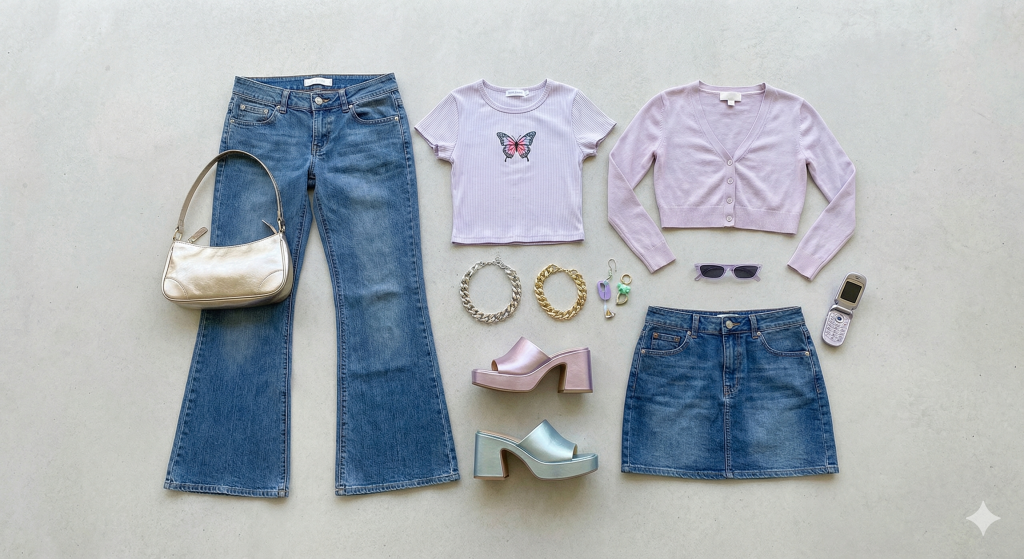
Let’s break down the iconic baby tee first. The shrunken, fitted nature of a baby tee is brilliant for highlighting a slender torso, but the hemline placement makes or breaks the look. You need the crop to hit exactly at your natural waist—the narrowest part of your midsection—rather than resting lower on the widest part of your hips. This creates an immediate hourglass effect when paired with the wider bottoms characteristic of the era. Lean into authentic Y2K details to maximize the upward pull: rhinestone graphics, classic ringer-style contrast collars, or bold, sassy slogans. The graphic itself acts as a literal focal point, anchoring the viewer’s eye squarely on your chest and face.
Beyond the simple baby tee, we need to introduce statement tops into your rotation. To match the visual weight of fuller hips and thighs, I look for tops that add architectural interest, volume, or strategic skin exposure around the neckline and shoulders.
- The Halter Top: This is a pear shape’s best friend. By cutting inward at the collarbone and exposing the shoulders, halter tops visually broaden your upper frame. Look for Y2K staples like chainmail materials, handkerchief/bandana cuts, or thick tie-neck styles.
- The Butterfly Top: Arguably the most recognizable Y2K statement piece. The structured, sequined wings naturally extend past the ribcage, adding necessary volume and sparkle to the bust and shoulders to balance out your lower half.
- Cowl Necks and Strategic Ruching: Fabric draped or gathered at the bust adds dimension exactly where a pear shape needs it most. A silky cowl neck camisole instantly elevates the upper body’s visual presence.
- Flared and Bell Sleeves: If you are wearing a long-sleeve top, avoid skin-tight sleeves. Bell sleeves or exaggerated flares at the wrist draw the eye outward, creating a horizontal line that perfectly counters the horizontal line of your hips.
To make shopping and styling easier, I’ve put together a quick cheat sheet for selecting the right tops to flatter your specific proportions:
| Y2K Top Style | Fit Trick for Pear Shapes | Authentic Details to Look For |
|---|---|---|
| Baby Tee | Hem must hit the narrowest part of the natural waist to avoid cutting you off at the hips. | Rhinestones, velvet flocked prints, contrast ringer hems. |
| Halter/Handkerchief | Ensure the back ties securely to lift and support the chest, drawing eyes to the shoulders. | Satin fabrics, paisley prints, asymmetrical pointed hemlines. |
| Cardigan Set | Leave the bottom few buttons undone to create an inverted ‘V’ that flares over the hips. | Faux fur trim collars, ribbed knits, tie-front closures. |
Chunky Footwear to Balance Lower Body Proportions
When styling a pear-shaped silhouette, the shoes you choose dictate the visual anchor of your entire outfit. If you pair wider hips and thighs with delicate, thin-soled footwear like kitten heels or flimsy ballet flats, you inadvertently create an inverted triangle effect on your lower half. This visually shrinks the ankles and calves, which instantly makes the hips appear significantly broader than they actually are. Chunky Y2K footwear is our styling secret weapon here. A heavy, substantial shoe adds visual weight to the very bottom of your leg line, instantly balancing out the volume of your hips and thighs to create a much more harmonious, grounded proportion.
In the styling studio, I rely heavily on specific late-90s and early-2000s footwear profiles to manipulate these proportions. Here are the exact chunky styles you should be integrating into your rotation:
- The Mega-Platform Sneaker: The undisputed anchor of the Y2K revival. I always recommend a platform height of at least 2 to 3 inches—think modern iterations of Buffalo Londons or the classic Skechers D’Lites. They pair flawlessly under the baggy cargo pants we’ve already covered, lifting the hemline just enough to prevent the heavy fabric from pooling at the ankles and adding unwanted bulk.
- Lug-Sole Loafers & Oxfords: Essential for capturing that pop-punk aesthetic. I love pairing these with ankle-length white socks and pleated micro skirts. The aggressive bulkiness of the shoe contrasting directly with the bare leg draws the eye downward, actively elongating the appearance of the thigh.
- Chunky Combat and Knee-High Boots: A heavy, treaded lug sole on a boot does wonders for smoothing out the calf-to-ankle ratio. If you are styling low-rise bootcut denim, a chunky combat boot underneath provides a seamless, continuous line that gives the illusion of legs for days.
- Flatform Slip-On Sandals: Channeling those iconic, stretchy Steve Madden slip-ons from 2001. They give you the crucial height of a heel without forcing an aggressive arch, keeping your physical stance slightly wider and visually balancing the pelvic width.
To make the application foolproof, I’ve put together a quick cheat sheet for matching these chunky shoe profiles with the hemlines that best flatter a pear shape:
| Y2K Shoe Style | Ideal Bottom Pairing | Proportion Effect on Pear Shape |
|---|---|---|
| Mega-Platform Sneakers | Baggy Cargos & Parachute Pants | Prevents bottom-heavy fabric pooling; elevates the leg line. |
| Lug-Sole Loafers | Micro Minis with Crew Socks | Anchors the bare leg; shifts focus away from the hip width. |
| Chunky Knee-High Boots | Low-Rise Denim Skirts | Standardizes lower leg width to match the upper thigh volume. |
The key takeaway I always give my clients is to embrace the heavy sole. You want the shoe to feel almost comically large when you pull it out of the box. Once you pair it with the signature oversized bottoms or ultra-short hemlines of the 2000s, that extreme chunkiness shrinks down visually, acting as the perfect counterweight to your natural curves.
5 Foolproof Y2K Outfit Formulas for Pear Silhouettes
Putting together a Y2K look when your hips are wider than your bust isn’t about hiding your curves; it’s about strategic geometry. In my styling sessions, I always rely on a few specific “plug-and-play” formulas that nail the early 2000s vibe while naturally complementing a pear silhouette. Let’s break down exactly how to execute these looks.
1. The Baggy Cargo Pants and Structured Corset Combo
This is my absolute favorite juxtaposition for a pear body type. You are pairing extreme volume on the bottom with rigid structure on top. Look for oversized, parachute-style cargo pants with adjustable drawstrings at the waist and ankles. The looseness around the hips and thighs provides effortless comfort, while a tightly boned corset creates a focal point at your narrowest measurement—the waist. To pull this off authentically, opt for a corset with a sweetheart or square neckline to add visual volume to your bust, instantly balancing your overall proportions.
2. Pleated Micro Mini Skirts and Knee-High Boots
Yes, you can wear the classic micro mini. The secret lies entirely in the pleat construction and your footwear choice. Avoid tiny accordion pleats, which tend to stretch and warp horizontally over wider hips. Instead, hunt for skirts with wide box pleats that sit flat against the upper hip before flaring out. Pair this immediately with chunky, knee-high boots—think square-toe leather or heavily buckled styles. The high boot covers the calf, adds visual weight to your lower leg, and creates a beautifully balanced, elongated leg line.
3. The Iconic Velour Tracksuit: Fit and Styling Guide
You can’t do Y2K without channeling the velour tracksuit era, but the fit is everything for our specific shape. The biggest mistake I see is wearing a zip-up jacket that ends right at the widest part of the hips—this creates a harsh horizontal line that visually widens your lower half. Instead, look for a slightly cropped jacket that hits squarely at your natural waist. For the pants, ensure they have a distinct flare or bootcut. That slight bell shape at the ankle perfectly mirrors the curve of your hips, creating a seamless hourglass illusion.
4. The Bias-Cut Slip Dress Over a Ribbed Baby Tee
Layering was the backbone of early 2000s street style. A bias-cut slip dress is a massive asset for pear shapes because the fabric is cut at a 45-degree angle, allowing it to drape fluidly over curves rather than clinging tightly to them. To make it strictly Y2K, layer a contrasting, tight-fitting ribbed baby tee underneath. The high neckline and bright color of the tee draw the eye directly to the upper body, while the slip dress skims the lower half flawlessly.
5. Low-Rise Bootcut Denim with an Asymmetrical Halter Top
Since we already established how to navigate low-rise bottoms, let’s put it into a complete, wearable outfit. Take your low-rise bootcut jeans—the flare at the hem is non-negotiable here for lower-body balance—and pair them with a dramatic, asymmetrical halter top. A top with an uneven hem, a cowled neckline, or one-shoulder detailing forces the eye to travel diagonally across your upper body. This dynamic movement up top anchors the whole outfit, making your broader lower half look like a deliberate, grounding element of the look rather than the primary focal point.
| Formula Focus | Why It Works for Pears | Stylist’s Non-Negotiable |
|---|---|---|
| Cargo & Corset | Contrasts loose bottom with structured top. | Corset must have rigid boning to cinch the waist. |
| Mini & High Boots | Boots add weight below the knee to balance hips. | Box pleats only; absolutely no accordion pleats. |
| Velour Tracksuit | Flare pants mirror hip width symmetrically. | Jacket must be cropped to the natural waist. |
| Slip Dress Layering | Bias cut drapes over hips; tee highlights bust. | Tee must be snug and hit above the collarbone. |
| Halter & Bootcut | Asymmetry draws eyes up; bootcut anchors feet. | Halter needs distinct diagonal lines or drapery. |
Insider Tip: Notice that every single one of these formulas relies heavily on the “Rule of Thirds.” We are never cutting your body directly in half visually. We are either cropping high at the natural waist or creating uninterrupted, continuous lines down the leg. Stick to this rule, and the proportions will naturally fall into place.
The Baggy Cargo Pants and Structured Corset Combo
The visual tension between a rigid, waist-snatching corset and oversized, puddle-hem cargo pants creates the ultimate proportion play for pear silhouettes. I pull this exact formula constantly for my styling clients because it mathematically balances the body: it aggressively highlights your narrowest point—the natural waist—while allowing the lower half to exist in comfortable, intentional volume. It channels that quintessential early-2000s music video energy without adding unwanted bulk to the hips.
Nailing the Structured Corset
Forget flimsy, stretch-lace bustiers. You need architectural support. Look for real acrylic or steel boning that forces the garment to hold its own shape rather than just contouring to yours. I always recommend a corset with an asymmetrical or curved dropped hem, specifically one that forms a subtle V-shape at the front center. This cut visually elongates the torso and draws the eye directly down the middle of the body, pulling focus away from the width of the hips. For the neckline, a severe square neck or a dramatic sweetheart cut creates a strong horizontal line across the décolletage, which provides the necessary upper-body weight to balance out bottom-heavy proportions.
Sourcing the Perfect Baggy Cargos
For pear shapes, the Y2K cargo pant is a minefield of pocket placements. The golden rule I enforce on set is zero 3D details on the upper thigh or hipbone. Any gusseted pockets, heavy zippers, or cargo flaps must sit at or below the knee. When shopping, prioritize stiff, non-stretch fabrics like heavyweight cotton twill or crisp nylon parachute material. These rigid fabrics drape straight down from the widest part of your hip, creating a clean drop. If you buy a thin jersey or flimsy satin cargo, the material will cling to your thighs and completely ruin the structural illusion of the baggy fit.
| Styling Element | The Industry Pro Tip | The Rookie Mistake |
|---|---|---|
| The Waist Gap | Leave a strategic sliver of bare skin (about 1 to 2 inches) between the corset hem and the pant waistband to break up the torso and scream Y2K. | Overlapping the corset heavily over the pants, which can make the midsection look thick and blocky. |
| Pant Rise | A relaxed mid-rise that sits comfortably just an inch below the belly button is the sweet spot for both era-accuracy and hip-flattery. | Extreme high-rise cuts that eat up your torso and fight the structured corset for visual dominance. |
| Color Strategy | High contrast styling. Pair a bright, metallic, or acid-wash denim corset with dark olive, charcoal, or camo-print bottoms. | Matching soft fabrics perfectly, which causes the pieces to blend together into a shapeless, jumpsuit-like silhouette. |
When you assemble this outfit, ensure the pants are long enough to create a “puddle” effect over your shoes. Letting the excess fabric pool slightly extends the visual leg line all the way to the floor. This trick adds essential inches to your perceived height and guarantees the oversized nature of the cargo pants doesn’t stump your lower half.
Pleated Micro Mini Skirts and Knee-High Boots
Pleated micro minis are arguably the most intimidating Y2K trend for those of us with wider hips, but they are absolutely wearable when styled strategically. The magic lies entirely in the structure of the pleat and the visual counterweight provided by the right footwear. A flat-front skirt with knife pleats that drop just below the hip bone acts as a natural A-line. Instead of clinging to your curves, the fabric flares slightly outward, skimming your lower half and creating a playful, hyper-feminine silhouette.
When selecting your skirt, fabric is everything. I always steer my pear-shaped clients away from flimsy, stretchy materials that cup the rear. You want structured denim, heavy cotton twill, or a classic wool-blend tartan. These materials hold their shape and maintain that crisp, cheerleader-esque flare that defined early 2000s pop culture.
Now, let’s talk about the second half of this equation: the knee-high boots. This is the non-negotiable anchor for this look. Wearing a micro mini with a delicate heel or ankle boot can leave a pear shape feeling visually disproportionate and bottom-heavy. A chunky knee-high boot—think a square-toe leather stomper or a heavily buckled motorcycle style—adds essential volume to the lower leg. This creates an unbroken vertical line that lengthens your legs and balances the width of your hips.
Here are my in-studio styling rules for mastering this specific combination:
- Cheat the Low-Rise: True Y2K fashion demands a dangerously low rise, but a mid-rise (hitting just an inch below the belly button) is often the sweet spot for pear shapes. It gives the illusion of the low-slung trend without digging into your hips or creating unwanted discomfort.
- Mind the Boot Gap: Pay attention to the space between the top of the boot and the hem of the skirt. For pear silhouettes, leaving about 4 to 6 inches of bare thigh exposed breaks up the leg line perfectly without overwhelming your frame.
- Layer with Leg Warmers: If you feel too exposed, add thick, scrunched-up knit leg warmers over the top of your boots. It’s a massive Y2K styling hack that adds bulk to your calves, further harmonizing your upper and lower leg proportions.
To make shopping easier, I’ve broken down the exact pairings that consistently work in my fitting room:
| Skirt Style | Ideal Boot Pairing | Why It Works for Pear Shapes |
|---|---|---|
| Heavyweight Tartan Pleated Mini | Chunky Platform Combat Boots (Knee-High) | The platform adds height, while the heavy boot sole grounds the busy plaid pattern, drawing the eye down. |
| Faded Denim Micro Mini (Raw Hem) | Slouchy Suede Boots (Pointed or Square Toe) | Slouchy boots add horizontal volume to the calves, balancing the visual width of denim on the hips. |
| Black Twill Tennis Skirt | Sleek Faux-Croc Stiletto Boots | Offers a more elevated, night-out Y2K vibe. The structure of the twill smooths the hip line. |
The Iconic Velour Tracksuit: Fit and Styling Guide
When I style a client who wants an authentic early 2000s look, skipping the matching velour tracksuit is never an option. However, for a pear-shaped silhouette, pulling off this iconic Paris Hilton-era staple requires a surgical approach to fit. The plush, light-catching nature of velour naturally adds visual volume, so we have to manipulate the cut to work with your proportions, not against them.
The pants are where the magic happens. Since we already know low-rise cuts can be tricky, the secret to nailing the velour bottom is the flare-to-hip ratio. I always recommend a pronounced bootcut or wide flare rather than a straight leg. The volume at the hem balances out the width of your hips and thighs, creating a balanced, elongated illusion. Ensure the drawstring waistband sits comfortably on your hip bones without digging in—sizing up is a non-negotiable insider trick here. You want the fabric to drape smoothly over your curves, completely avoiding any stretching across the thigh area which distorts the velour’s sheen.
The jacket length is your make-or-break element. A standard-length zip-up hitting exactly at the widest part of your hips creates a harsh horizontal line right where you want it least. Here is how I bypass that when putting together looks:
- The Cropped Approach: Hunt down a jacket tailored to hit just at the navel or your natural waist. This highlights the narrowest part of your torso before the pants flare out over your hips.
- The Unzipped Vertical Hack: If you are wearing a standard-length jacket, never zip it closed. Leave it entirely open over a fitted baby tee. The two parallel lines of the open zipper create a strong vertical column down your torso, drawing the eye up and breaking the visual width of your lower body.
Color choice heavily dictates how these tracksuits translate on a bottom-heavy shape. Monochromatic sets are your best friend because they create an unbroken line of color that elongates the entire frame. While baby pink and powder blue are deeply nostalgic, darker jewel tones like emerald, navy, or rich plum offer the unmistakable Y2K aesthetic with a naturally contouring effect.
| Tracksuit Element | Pear-Shape Best Practice | What to Avoid |
|---|---|---|
| Pockets | Smooth flat-front; flap back pockets with snap buttons (adds a nice lift to the glutes). | Bulky side-seam slash pockets that gape open and add inches to your hips. |
| Embellishments | Rhinestone logos placed high on the chest or across the shoulders of the jacket. | Heavy rhinestone wording directly across the widest part of the bum, which magnifies width. |
| Material Weight | High-stretch, mid-weight velour with a high cotton content to provide a bit of structure. | Flimsy, ultra-thin crushed velvet that static-clings to your thighs. |
To finish the look, roll up the jacket sleeves to expose your forearms and wrists. It sounds like a minor detail, but showing off these narrow points of the body adds an immediate sense of lightness to the heavy velour fabric, keeping the overall silhouette crisp rather than sloppy.
Essential Y2K Accessories to Elevate Your Look
Accessories are the secret weapons in any Y2K wardrobe, but when I style a pear-shaped figure, I use them as strategic proportion balancers. Since we’ve already established your outfit foundation with the right cargo pants and baby tees, we can now use finishing touches to dictate exactly where the eye travels. For your silhouette, the objective is high-impact, upper-body focus.
The Snug Shoulder Bag (Baguette Style)
Forget long crossbody bags that hit right at your widest point and add unnecessary bulk to your hips. I always tell my clients to swap those out for a classic Y2K short-strap shoulder bag. Whether it is classic nylon, faux-croc, or completely covered in rhinestones, a baguette bag tucks neatly directly under your arm. This naturally draws attention to your waist and bust line, adding a bit of visual volume to your upper half to effortlessly balance your lower body.
Draped Chain and Rhinestone Belts
You might assume wearing a belt low on the hips is a strict no-go for a pear shape, but it is entirely about the drape. Instead of a thick, rigid leather belt that cuts across your hips horizontally, opt for a delicate metal chain or a sparkly rhinestone belly belt. Let it sit loosely so it dips into a slight “V” shape at the front. This diagonal draping breaks up the width of the hips rather than emphasizing it, giving you that authentic 2000s pop-star energy without widening your silhouette.
Face-Framing Nostalgic Details
If you want to pull the gaze immediately up to your face, vintage hair accessories and eyewear are your best tools. I keep my set bag fully stocked with these specific pieces for pear silhouettes:
- Butterfly Clips & Mini Claws: Twist the front sections of your hair back and secure them with vibrant clips. It adds horizontal interest and playful texture to the top of your head.
- Thick Jersey Headbands: A sporty aesthetic staple that visually widens the crown, creating a subtle illusion of broader shoulders.
- Tinted Rimless Sunglasses: Think pastel pink, blue, or yellow gradient lenses. These act as a bright, reflective focal point right on your face, ensuring the attention stays up top.
Visually Heavy Jewelry
Minimalist, dainty jewelry gets completely lost in the chaotic fun of this aesthetic. We need pieces with enough visual weight to hold their own and anchor the upper body. I highly recommend stacking chunky resin rings—the brighter and more obnoxious, the better—and aggressively layering your necklaces. A thick velvet choker paired with a longer, silver pendant necklace fills the décolletage, drawing the eye straight up from your waist to your collarbone. It is an incredibly effective, stylist-approved trick to highlight the slender necks and shoulders typical of pear shapes.
Where to Shop for Pear-Friendly Y2K Fashion Pieces
Finding Y2K pieces that actually accommodate a smaller waist and wider hips requires knowing exactly which brands cut for curves. Let’s skip the frustration of gaping waistbands and rigid fabrics. Over the years of styling pear-shaped clients, I’ve curated a specific black-book of retailers and resale platforms where you won’t have to compromise on the aesthetic just to get a good fit.
The Modern “Curve-Cut” Y2K Revival
For staple bottoms like those low-rise baggy jeans and cargo pants we discussed earlier, standard sizing often fails the pear silhouette. You need brands that engineer their garments with a high waist-to-hip ratio in mind, even for low-slung styles.
- Abercrombie & Fitch (Curve Love Line): They have aggressively rebranded to dominate the modern Y2K space. Their “Curve Love” denim and parachute pants add an extra two inches through the hip and thigh, eliminating the dreaded waist gap. Look specifically for their “Low Rise Baggy” cuts.
- Jaded London: If you want authentic-looking Y2K streetwear—think oversized skater pants and heavily washed, distressed denim—this is my go-to. The reason they work so well for us is their heavy use of adjustable toggle waists. You can buy a size up to fit your hips effortlessly and cinch the waist tight.
- Good American: While known for classic denim, their recent drops feature excellent Y2K-inspired flare and bootcut styles with superior stretch recovery. This means the fabric hugs your hips without suffocating your thighs or losing shape by the end of the day.
Sourcing Authentic Vintage
Nothing beats the drape, wash, and detailing of authentic clothing from the early 2000s, but vintage sizing runs notoriously small and straight. When shopping resale apps, I always advise my clients to target specific brands that historically offered more generous hip allowances.
- Depop & Poshmark: These are your goldmines. When searching for true low-rise jeans, type in vintage Miss Me, Apple Bottoms, or early Rocawear. These brands specifically catered to curvier bodies back in the day. Always message the seller for flat lay measurements of the waist and the hip, aiming for a hip measurement that is at least 10-12 inches larger than the waist.
- eBay: The absolute best place to find those authentic velour tracksuits (Juicy Couture, Baby Phat). Because velour has inherent stretch and the pants feature drawstring waists, they are naturally pear-friendly. Just check the listing notes to ensure the elastic hasn’t completely degraded from age.
Quick Reference: Where to Buy What
| Brand / Platform | Best For… | Why It Works For Pear Shapes |
|---|---|---|
| Edikted | Cropped baby tees, sheer tops | High spandex content; stretches comfortably across the bust and shoulders while snapping back to highlight the waist. |
| Minga London | Pleated micro skirts, grunge-Y2K | Many skirts feature hidden side-stretch panels or wrap silhouettes that adjust seamlessly to your hip width. |
| Steve Madden | Chunky boots, platform sandals | Offers reliable wide-calf options for knee-high boots; consistent sizing for the heavy footwear needed to balance our lower half. |
| ThredUp | Hidden gems, wide hardware belts | Massive, easily filterable inventory to find wide, adjustable statement belts meant to sit perfectly low on the hips. |
When building out your wardrobe, I strongly recommend investing your primary budget into high-quality bottoms that actually fit your lower half. Save your money by snagging basic baby tees, butterfly clips, and accessories from fast-fashion or local thrift stores. A flawlessly fitted pair of Y2K cargos will do all the heavy lifting for your silhouette, allowing you to mix and match cheaper tops without looking like you compromised on quality.
FAQ
Q: I’ve always been told pear shapes should strictly avoid low-rise pants. Can I actually pull off the Y2K low-rise trend?
A: Absolutely. The biggest misconception I hear from clients is that low-rise bottoms are exclusively for straight or apple body types. The secret lies entirely in the cut of the waistband. Instead of a stiff, straight-across cut that violently digs into your hips, look for a V-shaped or contoured waistband. This cut dips slightly in the front and sits higher in the back, accommodating your hip-to-waist ratio without gaping. Pair it with a top that ends right at your natural waist to keep the visual focus lifted.
Q: Pleated micro mini skirts are a Y2K staple, but they always ride up significantly in the back for me. How do I fix this?
A: This is a classic pear-shape dilemma caused by the difference between waist and hip measurements. My go-to styling hack is to intentionally size up so the skirt fits your hips and glutes perfectly, then have the waist taken in by a tailor. It costs about $15-$20 and completely transforms the garment’s drape. If tailoring isn’t an option, look for Y2K-inspired skorts (skirts with built-in shorts) or asymmetrical hemlines that naturally provide an extra inch of coverage in the back while maintaining that aggressive micro-mini illusion in the front.
Q: How do I wear the baggy cargo pants trend without looking like I’m drowning in fabric?
A: The key to baggy Y2K bottoms on a pear frame is strategic volume control. When I pull cargos for pear-shaped clients in the studio, I strictly follow these rules:
- Fit the high hip: Ensure the pants are reasonably fitted through your upper pelvis and only start to bag out below the mid-thigh.
- Watch pocket placement: Avoid cargo pockets positioned squarely on your hips or upper thighs. Look for utilitarian details placed lower down on the leg, near or below the knee.
- Contrast the top: Always pair maximum bottom volume with a structured, skin-tight top—like a boned denim corset or a cropped halter—to spotlight your narrower upper body.
Q: Are there specific Y2K fabrics I should seek out or avoid for my bottom half?
A: Yes, fabric drape makes or breaks a Y2K silhouette on a curvier lower body. I keep a quick reference chart in mind when pulling vintage pieces:
| Fabric Type | Verdict | Styling Notes |
|---|---|---|
| Stiff Raw Denim | Avoid | Tends to gap severely at the lower back and adds rigid, unyielding bulk to the thighs. |
| Stretch Velour | Perfect | Hugs curves without digging; delivers quintessential early-2000s energy and extreme comfort. |
| Parachute Nylon | Use Caution | Can balloon unflatteringly around the hips. Ensure it has adjustable waist and ankle toggles to control the exact volume. |
| Heavy Twill/Canvas | Great for Cargos | Provides a heavy, structured drape if tailored properly at the waist, beautifully anchoring the baggy aesthetic. |
Q: Do chunky platform shoes actually balance my proportions, or do they just make my lower half look heavier?
A: When styled correctly, they are your best friend. A chunky platform boot or a heavily padded skate shoe adds visual weight to your feet, which parallels the width of your hips and creates a grounded, balanced look. However, to avoid the “clunky” effect, pay attention to color continuation. If you’re wearing black velour track pants, pair them with dark chunky shoes to extend the leg line. If you are showing bare legs with a mini skirt, a knee-high platform boot is far more flattering for a pear shape than a chunky ankle sneaker, as the tall boot creates a long, unbroken vertical line that stretches the silhouette.